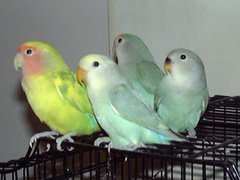
The Lovebirds

The Lovebirds
Perfect Pairs

Friday, July 8, 2011

SARCOCYSTOSIS IN LOVE BIRDS

Love birds are lovely pet and are preferred by many because of their attractive colour and pleasant demeanours. Like all other creatures these love birds too suffer from various disease problems and one such is sarcocystosis.

Sarcocystosis is a disease of birds that affects the love birds too. This disease is caused by parasite sarcocystis falcatula. Opossums only introduced these parasites in to the aviary. This disease doesn’t spread from bird to bird by direct contact, but the discarded infectious sporocyst can affect the healthy bird that comes in to contact. This disease is hyper acute in nature, hence the diagnosis is very difficult. Eliminating the opossums from the near by area is the best prevention method.

Sarcocystosis, this word has Greek origin. The word sarco means muscle or flesh. Sarcocyst means there is cyst in the muscle. Sarcocystis is the name of the parasite. These cysts are present in the muscle. The intermediate host species stay in the striated muscle. The intermediate stage is usually Benin stage. But the other developmental stages of the parasite in the other muscle create trouble, which in most cases results in the death of the bird.

Clinical signs of sarcocystis

The males are more prone than the female love birds. The cage mate dies all of a sudden. In most cases the other birds also get infection and die soon. But there are instances that the cage mate survives even after the death of the other bird. Prior to death the bird will have brief illness. There will dypnea, difficulty in breathing. The birds will be lethargy and there will be excretion of urates that are yellow pigmented. Clear fluid comes out of the mouth, the moment the dead bird is lifted for clearing. In some cases, the birds will appear as normal till the very second of death.
Treatment

As the diagnosis is extremely difficult, the treatment of the bird is hard to practice. However, in case the cage mate has died, the remaining bird can be protected. The drugs with antiprotozal activity can be given to the birds in various combinations. The supportive care is also should be provided along with the treatment. Pyrimethamine can be given in combination with trimethoprim-sulphadiazone, which destroys the parasite, thus protecting the bird. Pyrimethamine can be administered at the rate of 0.5 mg per kg 2 to 4 days. Then the dosage can be reduced to 0.25 mg per kg. The medication needs to be continued for 30 days. Trimethoprim-sulfadiazone is administered at the rate of 5 mg per kg by way of injection for a week.

All along the supportive care should also be provided. Supportive care is nothing but provision of gavage and oxygen. In case there is pulmonary edema, furosemide is administered by way of injection at the rate of 1.5 mg per kg.

Tuesday, June 28, 2011

Feather Picking and Skin Mutilation in Love Birds


We are living in 21 st century. The world is fast paced at this moment. The people are chasing the time. As the result, there is tension and tension every where. This is not going to be good for the health. One of the natural ways of managing the stress is pet rearing. Many like to go for dogs, cats and birds. In birds many prefer love birds as they are the symbol of love. Love birds have few vices one such is feather picking and skin mutilation. Here are little information about the feather picking and skin mutilation of the love birds.

Feather picking and skin mutilation is very common among love birds. The cause for the same can be medical or behavioural. Before attempting to correct the problem, the root cause of the problem needs to be ascertained. Only then, the correct remedial measure can be attempted. If, the root cause of the problem was not identified and corrected, then there is every chance for the recurrence, once the treatment period is over. Hence, the love birds needs to be examined completely by avian veterinarian. He will give his firm opinion after the complete check up of the birds.

We should always give the benefit of the doubt to the love birds and assume that the feather picking and skin mutilation is due the medical reason. If the veterinarian confirms that the birds are not having any medical problems then one can conclude that feather picking and skin mutilation is behavioral problem of the love birds.

Boredom is the major reason for the feather picking and skin mutilation of the love bird. There are details in the internet which deals at length about the ways are means of keeping the love birds occupied. The ways and means listed are easy to follow and less expensive.
As the love bird are kept in a cage for nearly 8-10 hours in a day without any activity and interaction, they are most like to get in to boredom sooner than latter. The love birds are very intelligent creatures. Their frustration can be compared to the frustration of young active child, who is kept in small playing pen for 24 hours a day.

One of the suggestion in the net is keeping the television on, preferably the discovery channel or animal planet. The love birds will enjoy this and be kept occupied. You can also talk to your pet love bird through answering machine. We can also add foraging opportunities to these little creatures to chase away the boredom.

There are few medicines that are very effective in relieving the stress in love birds. King bio Inc is a company that has a product called “stress control” which brings about amazing results in relieving the stress of the bird. This product is nothing but a natural herbal mix which helps in alleviating the stress not only in birds but also in other pets like dog, cat etc. This product helps to control the aggressive behaviors. This product can be just added to the drinking water to bring about the desired results. This product is hundred percent safe and has no side effects.

Sunday, June 12, 2011

Chronic Egg Laying in Lovebirds


In general the process of laying eggs in love birds is related to many factors. They are day length, food availability, behavior of the mate, rain fall, competition for nesting sites etc. egg laying in love birds is more or less controlled by any one or more factors mentioned above.

Chronic egg laying in the long run will result in depletion of calcium as the egg shell’s major constituent is calcium. This depletion of calcium results in a condition called hypocalcaemia. As the result the contraction of the uterine muscle gets affected. The eggs are not effectively pushed out which results in egg binding. Hypocalcaemia can also cause seizures and weak bones. The weak bones are fractured easily, thus maiming the love birds for life. Hence, excess egg laying needs to be stopped for the health of the love birds.

In case you have two females and have eight eggs in the nest then it is normal. If you ten or more eggs in the nest, then there is need to bother as chronic egg laying problem may have set in. The love birds are over doing it which needs to be controlled else serious health issues will follow as mentioned earlier.

The first and fore most things one has to do are providing complete diet. This complete diet will prevent the birds from the possible health hazards that follow chronic egg laying. There are few things one can attempt to discourage the love bird from laying eggs let’s discuss out here.

Let the eggs be not removed from the nest. The love bird will sit on the eggs which will halt the egg laying. Leave the eggs as it is for 21 days or till the bird lose interest on them. You can also use fake eggs in place of original eggs. Fake eggs made of wood are available in crafty stores for this purpose. There is no danger of breakage in wooden eggs.

The nest making material and the nesting sites may be removed. The paper and other material which are used for nest making should be removed. Let the bird be away from enclosed and dark spaces. The love birds prefer dark space for laying eggs, if such space is not available, then the laying is delayed. Prevent the bird from finding the dark space themselves under the couch, behind washing machine etc by keeping close watch on them.

Mimic shorter days. Let there not be bright light in the bird area. The hour of darkness should be increased. Let the bird go to bed early that is at 6 pm. Long day is major triggering factor for laying. Don’t put on the light early in the morning. Let the bird get up late. Thus the days are made shorter artificially to discourage laying.

Let the access to the food be limited. Let the food not be available all the time for the birds. Remove the food plate after the break fast. Let the food bowl be back late after noon. This will discourage laying as the birds have the habit of laying when food is available in plenty. But care should be taken to keep the bird in right weight. The bird should not lose weight which will lead to other complications.

Thursday, May 26, 2011

Sexing Budgies: Herculean Task?

Nowadays most of the lovebirds owners switch over to raising budgies as it is cheap to procure. But they have ended in sorrow due to the fact that they're unable to sex them.

The simple method for sexing Budgies is looking cere (the bit above it's beak). In male, it will be blue in color and in females they will be white cere with a hint of blue. It is very easy to differentiate adult and male. But the young ones are very difficult to differentiate. In young male, purple-pinkish colour cere is present and in females, they will have will have a pale blue cere with white rings around the nostrils.

See the picutres below and then you can sex the budgies very easily...

Male Adult Budgerigar


Female Budgerigar

Thursday, April 28, 2011

Lovebirds Microchipping

Microchipping provides a permanent and unique way of identifying a lovebird. The microchip can be inserted into the pectoral muscle tissue of birds.

The only advantage of using band than microchips is that the microchips are relatively expensive, and placing them into birds requires technical skill, but their use has proved successful in birds identification. Microchipping lovebirds is helpful in identifying them, which will provide necessary information like breeding, feeding of lovebirds to the lovebird owners. One step further, this technology is useful in wildlife conservation and field study programmes.

Will the lovebird bleed?

Birds won't bleed when you microchip them. If you notice a hole left by the needle at the insertion point, this can be repaired by tissue glue or suture.

Read more about

Microchipping - a Perfect method for lovebird Identification