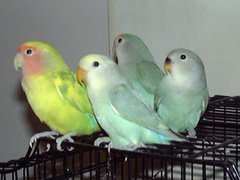
The Lovebirds

The Lovebirds
Perfect Pairs

Sunday, January 22, 2012

How to train lovebirds- the first step to successfully train a love bird

Are you the first time love bird owner? Do you want to know the ways and means of training a love bird? There are few steps one need to follow to train the love birds. Here is little information about the love bird training.

Gain trust

Gaining the love birds trust is first and fore most things in training the love bird. This is very much required if the love birds has not handled by anyone already. If the love bird is having any unwanted behaviour, then gaining the trust of the need of the hour. Biting is one such unwanted behaviour. Gaining the trust is easy. All one needs is little patience. The process should be started slowly.

To start with the love bird can be made to touch the tip of a small object like pencil or small stick. If the love bird can do that successfully, the birds should be treated or praised. Every time the bird responds positively, treat it again and again. Then proceed to touch command. For touch command one should use the finger or hand. The bird will slowly start trusting you. You also there after will handle the love bird with confidence. Gaining the trust of the love bird is the most crucial aspect in training the love birds as discussed already. Once that part is crossed, the rest of the thing will be easy.

Rewarding the love bird often

Once the trust is gained then one can move on to other new skill development. Stopping the unwanted sounds, coming to the owner as and when called, mimicking the sounds made by the owner etc are some of the new skills that can be taught to the love birds. Every time the bird obeys your command, the love bird needs to be rewarded with its favourite food or toy.

The key in love bird training is positive reinforcement. One should be aware of the love bird treat and one should have them in hand in sufficient quantity always. Nuts, millets, sun flower seeds etc are the treats that are liked by most of the love birds. Some love birds will prefer the love of the owner more than anything. Each love birds should treated as per its liking if they respond to the training well.

Perfect one skill at a time

The love birds are tiny little birds and hence do not try to teach them so many thing at a time. One should start with one skill at a time and the training should continue till the bird perfects it. Once the bird has perfected the skill, and then the other skill training should be attempted. Putting a ball in the loop, waving and turning around are some of the skills that can be taught to the love birds which will make them busy and chase away their boredom. If one tries to teach so many tricks at a time, then the bird will get confused and may not pick up anything and hence such practice should be avoided.

Sunday, January 15, 2012

Baby Lovebirds – How to care?

The love birds are very small and hence the baby love birds are tiny. Caring the baby love bird is not all that easy. If you are a starter here are few suggestions in this article about caring the baby love birds

Where to place them?

Sizable plastic type reptile container is considered best for the baby love birds for few weeks of their early life. The space provided for the baby love birds should be sufficient for their growth and at the same time the baby love birds needs to be safe there. The bottom of the pot should be lined with cage liner. The untreated papers should be used as towels above that. The cleaning on daily basis will be easy if these untreated papers are used. The food should be kept at the one end of the box and the space for cuddling should be at the other end. This way the possible clutter of the food part can be prevented.

When to take over for the babies parents?

The pet owner must know when the parents of the baby bird are allowed to take care, which is the first and foremost thing he should know. The entire clutch can be pulled out once the youngest baby love birds is about ten days old. The eldest baby love birds should be 16- 17 days at that time. If the baby love birds are older than 17 days then the hand feeding is bit difficult. If the love birds hatching is far apart and if the older baby love birds is older than 17 days by the time the younger baby love birds is 10 days old, then do not hesitate to remove the clutch two times.

Weaning

Abundance weaning approach is the most popular weaning method. This way the baby birds will be fed with syringe while there will be sufficient adult food also. This way the baby love birds will be motivated to eat the food themselves. As the days pass the baby love birds will slowly avoid the syringe feeding and will start eating their food on their own. It is always recommended that the weaned love birds are observed for some days for any health issues. Only on confirmation that there is no health issue the lovebirds should be sold.

Feeding from your hand

As discussed earlier, hand feeding is the best for first few weeks. Hand feeding is not all that easy and hence experienced trainers help is required instead of attempting is all by your self. The love bird baby food is available in pet stores and the same should be used for the baby love birds. For syringe feeding O –ring plastic syringe needs to be used. The baby love birds prefer warm food as they are used to regurgitated food. The ideal temperature required is 103 degree Fahrenheit. In case the food is warmed, care is taken to stir properly for uniform distribution of temperature to avoid heat burn.

Thursday, January 12, 2012

What to Feed my Lovebirds?


Lovebirds are such a wonderful creature and there is hardly anybody who does not love these tiny birds. These birds as the name suggest love to remain in pairs. These lovebirds spend hours together sitting side by side to its partner.

These birds are in fact smaller version of parrots. They grow to the size of 5 inches and can live for 15 years. Though these lovebirds are small, there is no shortage of activity and noise level. Many like to have these lovely creatures at home as pet. But most f them are not aware what to be fed to them. Here is little information about the feed for lovebirds.

The lovebirds like to feed on fresh and organic foods as they want to live close to the nature as much as possible. The love bird’s food can be pellets of fruits, vegetables and seeds. In wild the lovebirds mainly feed on seeds.

The parrots love to have variety of foods instead of feeding on the same food. Hence one should change the feed every day as there is a lot to be added in the food list such as cooked beans, pasta, fresh grains, brown rice, sprout, wheat grass, non toxic flowers etc.

There are many different verities of lovebirds right from red head to black collar and each species will have different liking when it comes to food. One should be aware of this fact. The black collared lovebirds are fond of fig fruit.

The food provided can be in the form of pellets or the food can be provided by soaking the same in water in order to soften the food. The food that is soft will be digested easily by the lovebirds. The water dish provided must be very clean. The water provided to the love bird should be free from contamination. The water bowls should be cleaned every day in order to avoid bacteria build up.

As discussed earlier, raw fruits and vegetables are good for the health of the lovebirds. But some birds will be very choosy about their food and such lovebirds are to be cared more and their specific requirement should be met with.

One has to be careful while providing the cooked food to the lovebirds. The cooked food should be allowed to cool before feeding. For example the cooked potato will be very hot and if provided as it is before cooling, the poor creature will get its beak damaged and at times the birds may die if the digestive system is damaged too badly. The food that was not consumed by the love bird for more than 24 hours should be removed from the cage and should be thrown out in the dust bin. There should not be any re heating and re using.

The lovebirds are very active and social animals. These birds are likely to slip in to boredom if not properly engaged. The boredom will lead to feather plucking, biting and screaming. One should aim at providing interactive way of feeding the lovebirds. Using food finding toys in case of pellets and skewers in case of fresh foods are recommended to keep the lovebirds in good spirit and to chase the boredom.

Wednesday, January 11, 2012

Things to think before rearing love birds

The love birds are named thus as these tiny birds love to interact and stay in pairs. These birds love to stay with her partner for long time. These birds sit side by side with the partner hours together. The name of these birds means "inseparables” in French and German.

These love birds are small parrots but these birds can make loud noises. Though these birds are small, they are aggressive in nature. Hence the pet owner should keep watchful eyes when these love birds are allowed to socialize with other animals, birds and other human beings.

Of late more and more people are opting for love bird rearing. But there are lot questions that need to be answered. The love birds are attention seeking creatures. Hence one should have sufficient time for spending time with these lovely creatures. These birds slip in to boredom if not proper attention and affection is paid which will affect the over all health of the birds. The boredom will lead to plucking of the feathers.

These animals should be fed properly and required water should be provided. There are so many health problems for these love birds just as the case of so many other animals. Hence there should be avian specialist help nearby. The love birds should be rushed to the specialist in case of any health issues.

The house should have large and safe space for these love birds. The lovebird rearing should be long time commitment. The households and the neighbours should be adjustable with the noise and the scream these little creatures make. If all those mentioned above is met with then one can think of rearing love bird without any hesitation. For the information, the average size of the love bird is 5 inch and the average life span is 15 years.

Tuesday, January 10, 2012

Grooming and hygiene of love birds


Grooming and hygiene of the love birds is very important as lot many people are allergic to the danders that comes out from the love birds. The love birds should be bathed in order to avoid this dander problem.

In winter months the love birds should be bathed -3-5 times and in summer months the love birds should be bathed 5-7 times at least. If the love bird of your likes to bath more often and the same should be encouraged as the birds will be clean and the plumage will look healthy and the allergy problems are reduced further.

There are many ways of bathing and each and every bird has their own preference. The love birds can bath as they wish in the wild but in captivity there are few limitations. Here are few ways in bathing the love birds in captivity. An extra bowel of water can be kept in the cage. The bowel can be seen hanging or can be kept at the bottom of the cage. The love birds can be sprayed with water using a bottle. If the aviary is kept outside, the love birds can bath in natural rain water. Some love birds prefer hot water, some prefer warm water and some other birds prefer cold water.

Clipping the flight feathers should never be practised in love birds as this will prevent the love birds from exercising [flying]. The love bird will only be walking and climbing around in the cage. The love birds love flying as it is their natural instinct.

The love birds also like to spend time with the pet owners. The love birds in general crave for attention. In you feel that clipping is necessary, and then you need to consult the avian specialist. If required, the nail and beak trimming can be done, but the professional help is required for this. The bamboo perches, if provided in the cage, then there is a possibility of natural way.