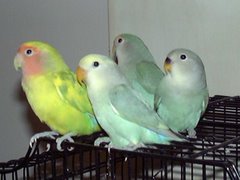
The Lovebirds

The Lovebirds
Perfect Pairs

Saturday, January 27, 2007

How to clean the lovebirds cages?

Do you know birds are the third most popular pets in US next to dogs and cats? Hence it is a high time to know about cleaning lovebirds cages as a pet owner.

Cleanliness is extremly important for continuous health and well being of the caged birds. Frequent cleaning is a must without stressing the lovebirds. Regular cleaning and disinfecting the lovebirds cage is an important criterion to keep them in good health. A thorough cage cleaning and disinfection should be carried out weekly.

The lovebirds in the cages should be removed and housed in another substitute cage for some time along with new perches. The cage shoud be subjected to shower, and run very hot water over them to remove excessive soiling.

The perches and toys also being cleaned under
hot running water. Scrub these acessories with non-toxic and bird-friendly cleanser. Again rinse the perches and toys in the hot water and dry it before fixing the same in the cleaned cages. Even you can dry the perches in the oven for 150-300 degrees after thoroughly rinsing them.

Glutaraldehyde can be used for disinfection purpose of the cage and floor. Weekly cleaning with hot soapy and mild disinfection may be carried out. A mild disinfectant like hypo chlorate, Lysol, QAC compounds can also be used.

If you do want to remove the stubborn spots on wooden perches or small wooden toy, you can try either sand paper to remove it or odor remover or enzyme-based stain (even you can use cat urine remover
).

If you are not willing to scrub the lovebirds poop, then you can use a do-it-yourself car wash. You can use it at least once in six months. You may be amazed to see the results of this method. But you should make sure that you rinsed away all the soap away.
Cleaning once in seven day keeps doctor away...

Tuesday, January 16, 2007

How to find your lovebird is healthy?

If you want to discover whether your lovebirds is in health or not, you ought to know the signs of health and illness. Healthy lovebird not only keep her happy but also the owners.

Signs of Health in Lovebirds

  • Bright eyes
  • Tight clean plumage
  • Alert demeanor
Signs of Illness in Lovebirds
  • Ruffled feathers
  • Bald perches
  • Sitting aloof
  • Revealing little interest in what is going on
  • Diarrheic (Greenish or watery one often)
  • Reluctantly feeding
  • Watery or yellow discharge in eyes
  • Reddening of eyes, which is an indication of eye infection
  • Discharge from nostril/beak
Once you find any illness symptoms, approach your vet as soon as poosible to get rid of the same. Otherwise it may lead to serious effects even the bird will succumb to death.

Saturday, January 13, 2007

Breeding Management of Lovebirds

Breeding a lovebird pair is really an enjoyable task. Seeing the hairless youngones in the nest will definitely bring about happiness not only among your family members, but also for the parent birds. The chicks will keep the parents busy to bring enough feed to them and also care to provide heat to their hairless body. Here you can get few points for an effective breeding managemt of lovebirds.

Breeding Cage

Minimum size: 70 cm long x 40 cm deep X 50 cm high

Cages for Lovebirds

  • Individual cage is a better choice for the breeding pair
  • Stainless steel wire cage or chromium plated cage mounted over a rough plastic bore is a perfect choice
  • The base and wire part of the cage is to be attached with special clips; so that basal part could be removed easily for cleaning purpose
  • Cages shall be placed in raised position, so as to provide the birds the feeling of security
  • Minimum size for a pair of lovebirds should not be less than 50 cm in diameter and 70 cm tall

Note: - A square or rectangular based cage is a better choice due to availability of increased volume.

Nest Box

Any form of compact activity (earthern pot/wooden box) with an entrance hole of about 5 cm in diameter is more than sufficient to lay eggs.The size of box is 15-17.5 cm square and 25 cm high. One nest box for each pair of birds. In case if you've taken the nest box for cleaning purpose, an alternate one should be kept in the same position for roosting of birds. Breeding is damn easy with peach faced love birds and mass breeding is successful in most species of lovebirds.
birdcare.com
  • The entrance hole should be just below roof.
  • A short perch should be affixed below entrance hole, so that bird can rest before entry (or) exit.
  • Access door (with rain proof facility) is a must, so that nest may be examined in case of emergency.

Eggs of Lovebirds

  • Usually 1-4 eggs will be laid by a female lovebird, which is the usual clutch size. (9 eggs from a single bird is also recorded). Incubation period is 21 to 23 days.
  • Laid every two weeks
  • Serious incubation will not commence until after the 2nd and 3rd egg has been laid, thus hatching time of all chicks occur within a day or two.

Thursday, January 11, 2007

Watering Management in Lovebirds

Ample supply of water is must for the lovebirds that are maintained in the cages. Water should be made available daily to these lovable creatures. The water shall be changed at least twice daily in order to occurrence of any water-borne diseases. The vessel needs to be cleaned and disinfected regularly. The watering system should be placed away from feeder and perches at the top to avoid contamination.

Normally, lovebirds will consume water twice the amount of feed. The water and feed ratio is about 2:2. If feed consumption rate is about 2 gms, it will consume about 4-4.5 gms of water.

Water consumption was found varying depending on hotness of the day, feed type, age of the birds, quantum of greens offered, body condition, etc. and hence, definite correlation could not be found out in general.

Now-a-days, automated watering system is being extensively used for lovebirds colonies. This system consists of vario-flo valves, flex tubing, and pressure regulators for the lovebirds. Using this automated watering system not only saves lots of time but also provide fresh and cool water, especially during warm and humid climate.

Keeping clean watering system, providing adequate water at any time inside cage and proper placement of the watering system helps a lot for your beloved lovebirds, especially preventing it from diseases.

Tuesday, January 9, 2007

Feeding Management of Lovebirds

Feeding plays an important role in the management of lovebirds. As a owner of a pet bird, you should awareof the feeds and feeders required for your lovebirds.

Open type / Hopper type feeder shall be used. A container holding 30 gms of feed is adequate for birds like budgerigars / lovebirds. Feeder should be kept away from the perch on the top in order to avoid direct falling of the dropping. Adequate space to facilitate flapping of its wings without the top/sides also being required.

Feeds
Cuttle fish bone or other supplement containing calcium should be readily available especially during the breeding season . (Hens take increasing time as laying time approaches)

Regular Feeds (suitable provision frequently)
Mix teaspoon of honey (or) corn syrup into a cup of hot milk and then add a beaten egg yolk and and a tiny pinch of salt and allow it to cool to lukewarm temperature. It should be placed in such a way that it can be easily removed for cleaning from outside the cage without frightening the bird.

Feed Storage

  • Avoid long time storage of feed.
  • Store the seeds properly in metal bins. (Clean, galvanized fresh can are ideal)
Note: Most birds dehusk the feeds before swallowing kernels. Hence, the husk frequently drop back into the food container, eventually concealing the uneaten feed. Hence feed them with dehusked grains.

Feeding Ration For Breeding / Molding Periods
Millets
(Various types) - 45%
Canary Feed- 30%
Sunflower seeds- 15%
Oats- 5%
Hemp- 3%
Niger Seed- 2%

Feeding Ration For Resting Period
Millets
(Various types) - 60%
Canary Feed- 20%
Sunflower seeds- 12%
Oats- 3%
Hemp- 3%
Niger Seed- 2%