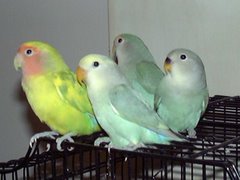
Closed Ring in Lovebirds
Congratulations!!! At last you have purchased a healthy lovebird. The next thing you should look at is their closed ring. All young birds born in captivity at a breeder’s wear a closed ring showing, among other things the year in which they were born.
A closed rings hold not be confused with a tag, which can be put on the leg of an adult bird to help identify it among other similar birds of the same species. If the bird is not wearing a closed ring, then it might have been imported (illegally) or caught illegally.
You should be particularly wary if the bird you are being offered belongs to a protected species or a species that is subjected to legal restrictions with respect to how the bird should be kept and ownership transferred to others and is not wearing a closed ring.
A missing closed ring does not always automatically means that something illegal is going on. If the breeder is not a member of a bird association, ten he will not be able to get these rings for his lovebirds. In such cases, it usually means that the bird was bred by a hobbyist or by accident.
In exceptional cases, it sometimes happens that the young birds have grown too fast, as a result of which it is no longer possible to fit them closed rings without actually hurting them. You should nevertheless be particularly careful if the bird is not wearing a closed ring.
A closed rings hold not be confused with a tag, which can be put on the leg of an adult bird to help identify it among other similar birds of the same species. If the bird is not wearing a closed ring, then it might have been imported (illegally) or caught illegally.
You should be particularly wary if the bird you are being offered belongs to a protected species or a species that is subjected to legal restrictions with respect to how the bird should be kept and ownership transferred to others and is not wearing a closed ring.
A missing closed ring does not always automatically means that something illegal is going on. If the breeder is not a member of a bird association, ten he will not be able to get these rings for his lovebirds. In such cases, it usually means that the bird was bred by a hobbyist or by accident.
In exceptional cases, it sometimes happens that the young birds have grown too fast, as a result of which it is no longer possible to fit them closed rings without actually hurting them. You should nevertheless be particularly careful if the bird is not wearing a closed ring.


 Free Ads For Bloggers


