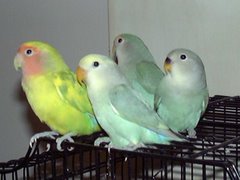
The Lovebirds

The Lovebirds
Perfect Pairs
Showing posts with label aviary. Show all posts

Monday, March 3, 2008

Housing Tips for Peach Faced Lovebirds

Peach-faced lovebirds , which during recent years have become one of the most popular sorts of cage birds, can be kept whether in a cage or an indoor or outdoor aviary. It does not matter much if the cage or aviary is higher than it is long or vice-versa.

However, the cage or aviary must be made of sturdy materials and be resistant to the birds powerful beaks. There is not much point putting plants in the aviary because the lovebirds will gnaw them to pieces in no time.

Peach-faced lovebirds are strong birds which do not require any heating if kept in an outdoor aviary during the winter. However, they should have access to a frost-free night house. You should also provide them with a (roosting) box in which they will use on cold nights.

Sunday, January 6, 2008

Social Characteristics of Fischer's Lovebird


As you know very well Fischer's lovebirds are native of Northern Tanzania. Both the sexes have identical coloring. The females are often slightly larger than the males, but this is not always the case. An experienced enthusiast can feel the difference between the pelvic bones which are wider apart in the case of the females of the species.

You can keep the birds as a pair but also in a small group. Although skirmishes may occur in the group these will not have serious consequences in a spacious aviary.

A pair of Fischer's lovebirds can also be kept in a cage in the living room without any problems occurring. You should purchase a pair simultaneously however, since a solitary Fischer lovebird may not readily accept an intruder, something which could have catastrophic consequences.

Saturday, December 1, 2007

Albino Masked Lovebirds


Have you ever seen albino masked lovebirds? A variety of mutations exist. Similarly to Peach-faced Lovebirds there are light, dark, and olive green mutations as well as mauve, sky-blue and cobalt-blue mutations, some times in combination with pastel.

Lastly, there are also lutinos (yellow with red eyes) and albinos (white with red eyes).
These albino lovebirds are lively and active and make use of all areas of the aviary or cage. They love to bathe in water and their call can be very loud and piercing.

It is better not to try breeding these birds before they are one year old. A suitable nest box will have a surface area of 10 sq.inches (30 cm). They build a nest from all kinds of coarse materials. They will produce 3 or 4 eggs that the female will incubate for between approximately 18 and 20 days.

But it is not sure, an albino masked lovebirds will give birth to an young albino young one- It all depends on the probability of Genes...