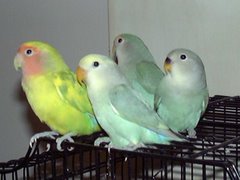
The Lovebirds

The Lovebirds
Perfect Pairs
Showing posts with label Peach-faced lovebirds. Show all posts

Saturday, September 24, 2011

Can you Keep Only One Love Bird?


There is a myth that the love birds should be kept as pairs only. This is absurd. The love birds can be kept as single bird, there are no qualms. But one has to definitely spare sufficient time with that lovely creature, else you are bound to have so many issues like behavioral problems, health problems etc. just like any other pet, the love birds too require constant attention, companionship, love etc. These little creatures certainly deserve the owner’s attention and time, is it not?

If not sufficient attention is provided, there can be several problems such as aggressive behavior, frequent screeching, excessive plucking of feathers, depression etc. if you are busy most of the time, then the best solution is providing a companion for these lovely little creatures.

The companion should be nothing but another love bird. It is good to have a love bird of the same species. Mixing up the species in love birds is not at all advisable. Match the peach faced love bird with the same variety but not with any other variety such as black masked love bird species. The reason is very simple; the love birds are very aggressive to other species and will never get along well.

Besides the love birds reproduce very often. The pet owner should be well prepared for that. It is not easy to find out the sex of the love birds by the physical appearance. DNA testing is the answer to the sex identification. All one has to do is sending the few feathers of the love bird to the near by veterinary hospital which has DNA analysis facility. It is always better to have love birds of opposite sex so that you will be benefited by the constant increase in the stock size.

Monday, March 3, 2008

Housing Tips for Peach Faced Lovebirds

Peach-faced lovebirds , which during recent years have become one of the most popular sorts of cage birds, can be kept whether in a cage or an indoor or outdoor aviary. It does not matter much if the cage or aviary is higher than it is long or vice-versa.

However, the cage or aviary must be made of sturdy materials and be resistant to the birds powerful beaks. There is not much point putting plants in the aviary because the lovebirds will gnaw them to pieces in no time.

Peach-faced lovebirds are strong birds which do not require any heating if kept in an outdoor aviary during the winter. However, they should have access to a frost-free night house. You should also provide them with a (roosting) box in which they will use on cold nights.

Thursday, February 28, 2008

Peach-Faced Lovebirds Breeding

Peach-Faced Lovebirds are quite easy to breed when compared to other species. However, pairing the birds can be quite difficult since the two sexes are very similar. It is best not to try breeding lovebirds younger than a year.

Lovebirds can be called as "pitbull of birds" and for good reason. Generally the hen can show aggression towards on its mate with no warning. You can find one dead bird in the cage once you return from office. Hence getting a suitable pair is really difficult. If you're successful in finding a suitable pair, then you will be rewarded with few clutches of cute little baby lovebirds.

A nest box with a surface area of approximately 10 sq. inches (25 sq. cm) is sufficient. In contrast to most other parakeets, these birds do make nests, usually using coarse twigs that they gnaw into strips.

Between 3 and 5 eggs are laid which the female incubates for between approximately 18 and 20 days. Fledging occurs at least a month or one and a half months after hatching. The very young birds of this species are recognizable due to their partially black beaks. Peach-Faced Lovebirds may well produce a number of clutches per year.

Saturday, December 30, 2006

Peach Faced Lovebirds

Peach faced Lovebirds can over winter in an unheated shelter. There is no special food for breeding; just make sure dandelion, chickweed or lettuces are always available. Sprouting millet spray is especially good.

Usually peach faced Lovebirds males will be green. Brow, head, neck and throat are pink in color. Rump is bright blue in color. Beak- flesh colored. But females are bigger and paler in its head.

Peach-faced Lovebirds inhabit the dry areas on the fringes of deserts. But generally they will be very near to the watering place. During the off-season of breeding they will move in flocks making a loud 'tsick-tsick' noise. They are fond of all kinds of berries.

In wild the nesting behavior is noticed in decayed tree trunks or take over nests abandoned by the Colonial Sparrow or Mahali Weaver. All three species will live together without infighting.

Peach faced Lovebirds are always available through the trade at a very attractive price. Even imported birds are hardy.

A single peach faced lovebird is perfect fit for keeping in the house. It quickly becomes tame and attaches itself to its owner. However, only undertake to keep your Peach-faced Lovebird in the room with you if you can bear its harsh voice, which is hardly ever silent.

Peach-faced Lovebirds are ready to breed in all seasons in your garden, if they maintained in pairs. As you think sexing of Lovebirds is not an easy task. Females have their feet much farther apart than the males; they are also larger.

When the peach-faced Lovebirds are ready for breeding (6-9 months age), you can feel their pelvic bones. In males, they are virtually touching, whereas in females they are far apart- you can feel a small space between them.

Introduce several young in an aviary at one time to build a good breeding population. It is not at all advisable to introduce new birds in with an old pair as this always leads to fights.

Breeding

The female bird always picks up the small barks to form nest linings. They always prefer to carry the small barks of lime trees, birches or willow, are normally 6-8 cm long and carried five or seven at a time by the female to the nest.

The built up nest would be dome shaped. The entrance is at the top, on one side, only the rear wall behind being left fairly open. For this reason, it is good idea to make the back of your nest box removable for inspection during incubation.

The female peach-faced Lovebird lays 3-5 eggs and incubates it for twenty-two days. The young ones have born featherless and able to fly away from the nest within five or six weeks. The father feeds them for the next two weeks because the female lays eggs again straight away.

As soon as the young become independent, it is wise to remove from the flock, or otherwise the parents could attack them. Try to avoid more than three broods a year.

General Management

Peach-faced Lovebirds are not suitable for colony-system housing. It is best to keep single pairs in small aviaries 6x6x3 ft is suitable, although excellent results had been recorded in aviaries of half these dimensions.

Peach-faced Lovebirds are spiteful with other birds, and have noisy, penetrating calls. They are hardy birds and do best in unheated indoor accommodation when not breeding in the winter. As bottom line, peach-faced Lovebirds are not only perfect fit for your garden but also your aviary.