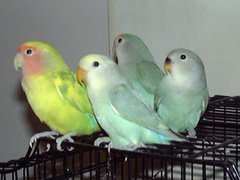
The Lovebirds

The Lovebirds
Perfect Pairs

Sunday, February 20, 2011

Fatty Liver Syndrome in Lovebirds

This is also called as hepatic lipidosis. This disease is a slow process occuring in your lovebird which made the liver tissue to get replaced with fat. The lovebird may suddenly fall sick as the fatty liver syndrome in lovebirds has progressed.

Female lovebirds are more prone to this disease which is due to the hormonal activities in the reproductive hen. Even young ones also being reported with this condition

CAUSES

  • Too frequent feeding or Over eating
  • Providing high fat content diet -all-seed diet
  • Nutritious deficiencies- Choline, Methionine and Biotin
  • Diabetes mellitus

SYMPTOMS of Fatty Liver Syndrome

  • Overgrown beaks and claws
  • Dry itchy Skin
  • Change in feather coloration - Poor feather quality
  • Greenish diarrhea due to biliverdin being excreted
  • Distended abdomen with the appearance of overgrown liver just below the keel
  • Dyspnea- Difficulty in breathing
  • In terminal stages, seizures are noticed

Prevention of Fatty Liver Syndrome

  • Provision of low-fat diet like fresh fruits and veggies and high quality pellets
  • Supplementation with Dimethylglycine (DMG), a perfect anti-oxidant
  • Administration of lactulose - to treat or prevent central nervous system signs
  • Fresh gel from the Aloe vera leaves may be prepared to administer the lovebirds

Fatty liver syndrome is a dreadful condition. In other words, it is difficult to cure. That's why we have to concentrate on preventing the Fatty Liver Syndrome well in advance by the lovebirds owner.

Wednesday, December 29, 2010

Things to Think Before Breeding Lovebirds

Congratulations for your decision of breeding lovebirds!!! Do you know there a few sets of things to think before proceeding so? Here I have given few limitations for breeding lovebirds, which you should keep in mind before performing this act of labor of love.

  1. Ask yourself if you really want to breed lovebirds. If so, fix a goal and ascertain what you’re going to do with the hatch chicks,
  2. Choose before breeding how many would you want to keep.
  3. Work out properly if you want to perform cross breeding to get color mutations.
  4. This act of breeding is really expensive. So don’t breed them for money.
  5. Pairing of lovebirds should be done before mixing them together. This can be done by feather and blood DNA testing services.
  6. Don’t believe on natural pairings as both females may also get paired up and there is every possibility of producing infertile eggs.
  7. Breed them at right age. Say, 10 months old for both male and female is perfect.
  8. Restrict breeding lovebirds in the warm months of the year as they need a high humid environment in the nest during incubation.
  9. Base of the nest box should be filled with damp organic debris – Bark of trees, pieces of straw, etc.
  10. Try to allow parent Lovebirds feed their young for two to three weeks. Then you can hand-feed the young one for successful rearing.

All the best!!!

Monday, December 27, 2010

Tantrums of Lovebirds

The common tantrum observed with most of the lovebirds is Screaming. The lovebird will scream only when a particular owner is present in his room.

Most of the owners try different methods to avoid screaming. Even one of my client asked is it possible to train her lovebirds. No need to train your lovebird. There is a simple way to treat this lovebird tantrum.

The best way is to get out of the room when the lovebird is screaming. Now he will learn that if he wants to be around you he has to be at least reasonably quiet. He remembers it doesn't work in a few seconds and fluffs up all cute and blows kisses and flirts which you find much harder to ignore.
Hope this works for you...

Thursday, December 23, 2010

How to Care Baby Lovebirds?

For a lovebird owners, losing baby lovebirds is really a discouraging experience. My first advice is don't try to hand feed your baby lovebird unless otherwise the mother disowned her chicks. In the case of mother's demise, you should try to adopt hand feeding of baby lovebirds.

If you buy a baby lovebird from market, then you should know where to place it. A plastic-type reptile container is more than sufficient to rear them for couple of weeks because it will give enough room to grow as well as keeping them safe. Try to place the food at one end and make the baby lovebirds to utilize the other end for cuddling. This will help you to prevent the birds making clutter in their food spot.

Use plastic-type O-ring syringe to feed birds with the baby bird formula, which you can obtain from any animal nutritionist.

Always provide warm food because the young one always gets regurgitated food from its mother. The preferred temperature of food should be 103 degrees.

Wednesday, October 20, 2010

Rearing Lovebirds- Is it Expensive?

Do you think rearing lovebirds is expensive? No!!! Just for $60, you can get a pair and start hand raising them in an effective manner. It is better way to ease your tension. You’re always better off you get from a breeder to feed the chicks by hand. You pay less, than from a Petstore, have a healthier bird, and it is already tame for you sein.

You can easily maintain them by providiong suitable toys and feeds of interest to them. They will be very happy in your home. They are very, very smart, good at escaping from their cage, and love to play with anything and everything. So be very careful in handling them. The attempt to tame you can get from a pet shop be hard. Hence it is highly advisable to get a pair from breeder than a pet shop.