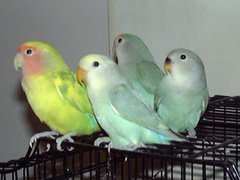
The Lovebirds

The Lovebirds
Perfect Pairs

Thursday, July 26, 2012

Tips for successful lovebirds breeding


A healthy lovebird is a good breeder in near future. Hence it is mandatory to improve the health of your lovebirds in your cage. Here the few steps that will help you to maximize the breeding potentiality of your lovebirds.

Age of breeding

 As a lovebird’s breeder, you should know the age of your lovebird. The lovebird between 1 and 5 years old is suitable for breeding. The sex ratio should be 1 male for 5 females.

Nest boxes

Nest box plays an important role in breeding lovebirds. Nest box should be of 12 inches x 12 inches x 12 inches. The entrance hole in the nest box should be of 3 inches diameter.


Nutritional care

During breeding season, you should feed the lovebirds with fresh fruits, vegetables, and greens (Coriander leaves).  Supplementation with calcium is essential for the hens that are going to lay eggs.

Sexing of lovebirds

Do you know lovebirds are sexually monomorphic? It is very difficult to differentiate male and female as the species look alike. DNA sexing is the only way to ascertain the sex of the bird.

Laying of eggs

Female lovebirds will lay at least 3 to 7 eggs on alternate days.  In general, they will lay eggs after 5-7 days of mating.

Period of Incubation

Lovebirds will incubate the eggs for 23 days. You should calculate the days of incubation start from the day on which the hen sits on the egg continuously

Hatchling care

Both sexes will take part in hatchling rising by feeding the chicks daily. Extra feed such as green food and soaked seeds (millets) are of best choice. In general chicks will come out of the nest box at the age of six weeks. No chicks will remain in the nest box after eight weeks of age. The young ones will make use of nest box for night stay for two more weeks. You should keep in mind that once the young one learned to feed independently, it should be move on to another cage, otherwise the male will try to kill the offspring. 

Monday, July 16, 2012

Swollen head in lovebirds- Why?

One of my client rang me up two days back with a symptom of swollen head in her lovebird. Immediately I rushed and inspected the bird, it showed following symptoms: -

1. Ruffled feather
2. Swollen ear lobes
3. Swollen head
4. Lacrimation (watering of eyes)
5. Rotten smell nasal discharge

 This clearly suggestive of infectious coryza.  Infectious coryza is a specific respiratory disease in pet birds that occurs most often in semi-mature or adult birds caused by Hemophilus paragallinarum bacterium.

Transmission is by contact between birds. Other predisposing factors include ingestion of contaminated food stuff and water, and inhalation of infected aerosols. Improving the hygiene, and proper disposal of dead birds are the measures to prevent infectious coryza.

Antibiotics such as tetracycline, enrofloxacin may be useful to prevent further spread of this disease of head swelling in lovebirds..

Tuesday, March 27, 2012

Breeding Love birds – a Daunting task?

In fact the breeding of the love birds is loads of fun, many are not aware of this. Breeding the love bird is addictive, challenging but also educational and emotionally fulfilling. The breeding is not a cheap affair. Breeding is expensive, frustrating, heart breaking and tiring. The good and bad, both are the part of the love bird breeding. The good thing is that the person will be fascinated about the birds and he will love to lose sleep in order to learn more about the birds. The person should have lot of money to spend on the bird, cage, food and the vet bills.

If earning the money is the motive of love bird breeding then one should keep away from the breeding activity. The efficient love bird breeders are just breaking even. Few others are making very less profit. There are hardly any who are making a living out of it. There is belief that working in taco bell will give more than having love breeding unit. So if are really interested in love bird breeding, you can go ahead.

There are few questions that are required to be answered. How serious you are in love bird breeding? Do you want to have just one or two pairs of birds or want to have big aviary? What will you do with the hatched birds? Do you have sufficient time to take care of the chicks or will you leave the chicks to their parents to care? Do you have any plan for selling the chicks? There is a common belief among the breeders that selling the chicks is difficult job than rearing the birds.

It always better to have plan in place for you and for the birds. You should have alternate plan to tackle the adversity if there is anything. You should be aware of the goals to be reached and the limitations that are there. The number of birds you want to have should be decided well in advance. You should have clear plan about of the colour of the love bird you want to produce. You should know from where you should get the birds for your requirement. The cost required for purchase of the seed stock, feed, equipment, other appliances etc. You should be aware of the number of chicks that you will be producing and the price at which you will be selling them in the market. You should be aware of the marketing channel.

The best thing for the new breeder is that to start the thing very small. Increasing the size of the aviary is much easier than decreasing the size of the aviary. If you start the small unit then there is a chance that you will learn the business with ease and lot more attention can be paid to the breeding activity. Many breeders loose their interest in the breeding activity if they do not have the perfect plan in place to sell the produce. Hence it is advised that you should have the perfect plan before the start of the breeding activity.

Thursday, March 22, 2012

Lovebirds Cage painting Tips


Have you ever painted lovebirds cage? Yes!!! Most of us think that it is highly dangerous to paint the cage with normally available paints as it is injurious to health of the birds. If you want to give perfect lovebirds care, you should read this article on Lovebirds cage painting.

Nowadays almost all the paints sold in US are edible when dry. Medias are crying hue and cry about this fact of painting birds cage should be be taken very seriously. The government assure that all paints available to residential home owners lack zinc or lead. So, you can paint any color to your lovebirds cage.

The best paint to apply over lovebirds cage is Powder-coated baked on finishes. A dry powder is sprayed onto the surface in a new cage.

Sunday, March 18, 2012

Is it good to separate the pair of lovebirds?

This situation arises with my friend. One of the lovebird always shouting like anything to call the birds outside from his home. The other lovebird that is silent started to shout once the other one shout. He tried to separate these two by giving one to his friend. Do you think this will solve this lovebirds care problem? I don't think so!

I feel its much better to keep them together. I asked him whether he tried any alternatives? I adviced him to change the cage position as well as rearranging furniture so to act as sound barriers.

The major reason for the birds are louder are as follows-

1. when they may be bored. So give them new toys, things to destroy, chew on etc.

2. Go outside and see how loud they really are. Ask neighbors also...

3. Try to get a new home.

It is not at all advisable to separate them. Separation will definitely worsen the situation as the remaining bird will call for it's mate.