The Lovebirds

The Lovebirds
Perfect Pairs
Showing posts with label lovebirds care. Show all posts

Thursday, March 22, 2012

Lovebirds Cage painting Tips


Have you ever painted lovebirds cage? Yes!!! Most of us think that it is highly dangerous to paint the cage with normally available paints as it is injurious to health of the birds. If you want to give perfect lovebirds care, you should read this article on Lovebirds cage painting.

Nowadays almost all the paints sold in US are edible when dry. Medias are crying hue and cry about this fact of painting birds cage should be be taken very seriously. The government assure that all paints available to residential home owners lack zinc or lead. So, you can paint any color to your lovebirds cage.

The best paint to apply over lovebirds cage is Powder-coated baked on finishes. A dry powder is sprayed onto the surface in a new cage.

Sunday, March 18, 2012

Is it good to separate the pair of lovebirds?

This situation arises with my friend. One of the lovebird always shouting like anything to call the birds outside from his home. The other lovebird that is silent started to shout once the other one shout. He tried to separate these two by giving one to his friend. Do you think this will solve this lovebirds care problem? I don't think so!

I feel its much better to keep them together. I asked him whether he tried any alternatives? I adviced him to change the cage position as well as rearranging furniture so to act as sound barriers.

The major reason for the birds are louder are as follows-

1. when they may be bored. So give them new toys, things to destroy, chew on etc.

2. Go outside and see how loud they really are. Ask neighbors also...

3. Try to get a new home.

It is not at all advisable to separate them. Separation will definitely worsen the situation as the remaining bird will call for it's mate.

Sunday, February 5, 2012

Get to Know about Masked Lovebirds

The pet owners just love the lovebirds like anything. One should not get fooled by their size. Lovebirds are true parrots. As these birds are very small in size, their accommodation can be small as well; hence the expense is very much less compared to the full size parrots. Lovebirds care is utmost important for a pet bird owner

Most of the species of lovebirds are native of Africa and Madagascar. As the name suggests these birds love their partner very much and remain close to each other hours together. These love birds do fight savagely with their own species at the time of breeding. Though these birds are small, they can adjust with most climates. As these lovebirds are quiet and good breeders in captivity, these birds are ideal aviary birds. The lovebirds can not talk but are very intelligent creatures. These lovebirds can survive up to ten years and no longer than that.

The lovebirds are very popular exhibition birds. There are more numbers bird club in United States of America which is very much interested in love birds. Peach faced, Fischers and masked love birds are bred by many. The other species are generally termed as rare as they are unknown to aviary. They are nyasal love bird, Madagascar love bird, black cheeked love bird, Abyssinian love bird, red faced love birds,black collared love bird, and black masked love birds.

The head of the black masked love bird is black and plumage colour is green. The collar will be yellow in colour. The other important characteristic of this species is white ring that encircles both the eyes. In addition to traditional green, so many other colour morphs are also noted in few birds. Blue morph is the most popular in western hemisphere. The first mutation is the blue mutation that came in existence from the wild stock. Albinos, pastel blue, and cinnamon pied are the other colour mutations that are bred in United States of America. Pastel blue is a mixture of dilute green and blue.

The Black masked lovebirds are native of Africa. These love birds can also be found on the islands of north east Tanzania. These love birds are hardy species and the Australian breeders, most of them propagate these birds in colony system. The masked love birds tend to dip pieces of their nesting material in the water in order to soften them and to retain the humidity in their nest

Saturday, August 27, 2011

Lovebirds as Pets- Five Things to know about Lovable Lovebirds


Are you raising lovebirds as pets? Then, this article would be a great boon for you. Love birds are very beautiful creatures and are nothing but small parrots. Often these love birds are confused with peach faced birds because of the size and col0r these two birds share. Love birds are available in so many colors and every one is sure to delight the potential owner. Let’s discuss five important things to the lovebird owners who are keeping lovebirds as pets...

1. Singles or doubles

The pet owner can go in for one bird or two depending on his liking and life style. If one can spend time with the periodically and can think of having one bird. The others who cannot spare their time with birds for long time, then they should consider two birds. Having two birds will certainly benefit the love birds as each will be companion for the other and will stay healthy for long time. But the owner should be aware that the expense will be double. The other danger is that the birds will develop stronger bond between them than the owner.

2. Let’s do lunch

The food provided to the lovebirds should have all the nutrients required. Lovebirds care starts right from its nutrition. The birds should be provided clean water all the time. The fruits, vegetables, seeds, sprouts etc should be provided periodically. Cut bones/ Cuttle fishes need to be provided as a source of calcium. Let the color of the food and the texture change to make the birds enjoy the food. For information about the recipe one can log on the internet. One can get information about home made foods for the love birds. The love birds should NEVER BE GIVEN chocolate, alcohol and caffeine as they are toxic to love birds.

3. May I have your attention please?

The love birds require lot of attention. Hence please spend your leisure time with the love birds as much as possible. Your attention will keep the birds not only happy but also healthy. The love birds will be emotionally attached with the owner, if more time is spending with them. Daily interaction with the love bird will help to eliminate the unwanted behaviors such as biting the other pet, biting the people, feather plucking etc

4. Did you stay quiet?

The love birds will be constantly making noise. Some may think that it is nasty. Some may just enjoy this and consider it as normal. The noise level depends on the love birds you have and the tolerance level of the owner and his family. If it is individual house with lawns and garden then the noise level can be very well tolerated. But in apartments, the love bird’s noise may become a problem for you and the neighbors. The love birds are not generally good talkers but at times they can speak few words.

5. Love is in the air

For the health of the bird, the quality of the air also matters most. High efficiency particle arresting air purifier is the best and can be recommended. This air purifier removes the pollutants in the air which carries the bacteria and viruses that will lead to infection there by causing serious health problem. This air purifier will help the love bird happy and healthy.

So, you have learned few things to keep your lovebirds as pets. This will definitely help your lovebirds to live hale and healthy.

Sunday, February 28, 2010

Lovebirds Day Out...


When your lovebirds escaped out of cage, what will you do? It happened yesterday. A pair of lovebirds from my cage escaped out and sat in the tree in my garden. I managed to capture them back by placing its favorite food in the cage. As I have trained them, within no time, both of them are in cage. So lovebirds training is more important. Now only I have learned the advantages of lovebirds training.

Although you can't train your lovebird like dogs, you can try simple ways to obey your words. I have discussed this in my blog- How to train lovebirds? Do search and get to know about the lovebirds training technique. Training is an important part in lovebirds care. All the best!!!

Thursday, April 23, 2009

Things To Avoid Feeding Lovebirds

You should not feed your lovebirds with rhubarb, avocado and chocolate. In addition to this, you should not provide any beverages containing alcohol or caffeine. Some of the lovebird owners are ready to give foods rich in monosodium glutamate (MSG), sulfites, nitrites, or nitrates. Avoid feeding processed meat also! Apple seeds, fruit pits, fava and navy beans, sprouted lima, and onions should not be given as a feeding stuff.


It is always advisable to avoid any foods high in sugar, salt or fat and junk foods. Lovebirds are suffering from lactose intolerant, so milk and milk products should be avoided. But you can give little quantity of yogurt and hard cheese.

As a prestigious lovebird owner, I can give a valuable suggestion to avoid feeding peanuts in the shell as they might be contaminated with Aspergillus fungus - a precursor for respiratory distress. This fungus produces a toxin called aflatoxin, which will damage the liver. Good quality human grade peanuts are advisable to feed the lovebirds than a mold infected peanuts. Blanched (unsalted) and shelled peanut are highly advisable.

What is The Best Feed For Lovebirds?

All food with no signs of mold are highly appreciated to feed the lovebirds because feeding plays an important role in lovebirds care. All the Best!!!

Monday, June 30, 2008

Love Birds - What Does it Take to Care For These Special Pet Birds?

You've probably seen these gorgeous birds in your local pet store. They are the miniature green parrots with the big expressive eyes. Love Birds are a good choice for someone who wants a parrot, but doesn't want the commitment that a large parrot requires. A large parrot such as a Macaw can live for 60 or more years, while a Love Bird seldom lives more than 15 years.

Before you go out to buy a Lovebird, you should be aware of what you're getting into. Lovebirds, like all parrots, are relatively high maintenance pets and therefore require a dedicated and special type of pet owner. Here are some important factors to keep in mind.

Companionship

Love Birds, like all parrots, are extremely social creatures and crave the company of others. If you don't have a few hours to spend with him every day, then you'll need to buy another lovebird to keep him company. Without the companionship of humans or another bird, your bird is likely to exhibit problem behavior such as extreme aggression, excessive preening and constant squawking.

Choosing The Right Lovebird

An ideal lovebird will be 6 to 10 weeks old and hand--fed. A young, hand--fed bird is much easier to tame and train than an older, parent--fed lovebird. The most commonly available species are:

  • Peach Face - This species is usually green, with a peach head, face and neck.
  • Fischer's Lovebird - This bird has a green body with shades of yellow and orange on their head and neck.
  • Masked Lovebird - This bird has a green body, with a dark brown colored brown mask around their face and neck. Just below this mask is a yellow band of feathers.

Housing

Love birds require a large cage with plenty of room to stretch out their wings and play -- obviously a pair will require a larger cage than a single bird. The majority of the cage bars should be horizontal and there needs to be a few perches located at varying levels. Place plenty of toys in their cage to keep them stimulated.

Health

Love Birds require daily exercise to keep them healthy. This means you should let them out to fly every day in a safe room. Make sure there are no open windows or predators (such as dogs or cats) in this room.

You should feed your love bird a quality parrot seed mix and plenty of fresh, clean fruits and vegetables that are bird--safe. This will give them a good variety that matches what they might find in the wild. You'll need to remove any uneaten food every day.
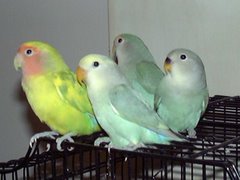
Learn more about Love Birds at http://www.petcarejournal.com/love-birds.html - a website designed to provide you with pet articles and resources that will help you get the most out of your pet keeping experience, no matter what type of pet you own.

Monday, December 25, 2006

Why Lovebirds are Called So?

It is an accepted fact that much information is available on various species of mammals but not with birds especially lovebirds. It is also equally true that specific technical information is highly lacking with particular species of bird, despite the frequent and common encountering of such birds by bird lovers or aviary owners.Before knowing the lovebirds care, it is essential to know about why lovebirds are called so?

In these circumstances, there is need to bring to limelight some salient features pertaining to captive reared lovebirds and in this regard, this blog was chosen and useful technical information are gathered which will be of highly useful not only for veterinarians but also for common people or aviary owners who rear such beautiful birds.

They are called as lovebirds because they sit together on a perch, preen each other and generally behave in a loving manner; however, it is to be remembered that most lovebirds are notoriously aggressive towards other birds and towards non-familiar member of their own species. Hence take more caution during introduction of new birds to existing stock in cage or aviaries and hence, the name may even be a misnomer!