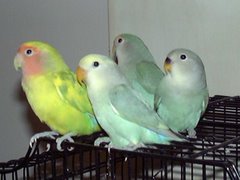
The Lovebirds

The Lovebirds
Perfect Pairs
Showing posts with label breeding. Show all posts

Tuesday, March 27, 2012

Breeding Love birds – a Daunting task?

In fact the breeding of the love birds is loads of fun, many are not aware of this. Breeding the love bird is addictive, challenging but also educational and emotionally fulfilling. The breeding is not a cheap affair. Breeding is expensive, frustrating, heart breaking and tiring. The good and bad, both are the part of the love bird breeding. The good thing is that the person will be fascinated about the birds and he will love to lose sleep in order to learn more about the birds. The person should have lot of money to spend on the bird, cage, food and the vet bills.

If earning the money is the motive of love bird breeding then one should keep away from the breeding activity. The efficient love bird breeders are just breaking even. Few others are making very less profit. There are hardly any who are making a living out of it. There is belief that working in taco bell will give more than having love breeding unit. So if are really interested in love bird breeding, you can go ahead.

There are few questions that are required to be answered. How serious you are in love bird breeding? Do you want to have just one or two pairs of birds or want to have big aviary? What will you do with the hatched birds? Do you have sufficient time to take care of the chicks or will you leave the chicks to their parents to care? Do you have any plan for selling the chicks? There is a common belief among the breeders that selling the chicks is difficult job than rearing the birds.

It always better to have plan in place for you and for the birds. You should have alternate plan to tackle the adversity if there is anything. You should be aware of the goals to be reached and the limitations that are there. The number of birds you want to have should be decided well in advance. You should have clear plan about of the colour of the love bird you want to produce. You should know from where you should get the birds for your requirement. The cost required for purchase of the seed stock, feed, equipment, other appliances etc. You should be aware of the number of chicks that you will be producing and the price at which you will be selling them in the market. You should be aware of the marketing channel.

The best thing for the new breeder is that to start the thing very small. Increasing the size of the aviary is much easier than decreasing the size of the aviary. If you start the small unit then there is a chance that you will learn the business with ease and lot more attention can be paid to the breeding activity. Many breeders loose their interest in the breeding activity if they do not have the perfect plan in place to sell the produce. Hence it is advised that you should have the perfect plan before the start of the breeding activity.

Thursday, February 28, 2008

Peach-Faced Lovebirds Breeding

Peach-Faced Lovebirds are quite easy to breed when compared to other species. However, pairing the birds can be quite difficult since the two sexes are very similar. It is best not to try breeding lovebirds younger than a year.

Lovebirds can be called as "pitbull of birds" and for good reason. Generally the hen can show aggression towards on its mate with no warning. You can find one dead bird in the cage once you return from office. Hence getting a suitable pair is really difficult. If you're successful in finding a suitable pair, then you will be rewarded with few clutches of cute little baby lovebirds.

A nest box with a surface area of approximately 10 sq. inches (25 sq. cm) is sufficient. In contrast to most other parakeets, these birds do make nests, usually using coarse twigs that they gnaw into strips.

Between 3 and 5 eggs are laid which the female incubates for between approximately 18 and 20 days. Fledging occurs at least a month or one and a half months after hatching. The very young birds of this species are recognizable due to their partially black beaks. Peach-Faced Lovebirds may well produce a number of clutches per year.

Wednesday, October 31, 2007

Breeding of Masked Lovebird

It is better not to try breeding masked lovebirds before they are one year old. a suitable nest box will have surface area of 10 sq. inches (25 sq. cm) and a height of 12 inches (30 cm) .

They build a nest from all kinds of coarse materials. They will produce 3 or 4 eggs that the female will incubate for between approximately 18 and 20 days.

Fledging occurs after 45 days. A couple of weeks after the young have left, the parents may start acting aggressively towards them so it is better to remove the young birds in good time. These birds may well produce a number of clutches per year, but you should be careful not to exhaust them by removing the nest box after the second clutch.

Monday, August 6, 2007

Breeding Season Aggression in Lovebirds

Don't think lovebirds will choose partners easily. It is quite often the case that birds that have been put in the same breeding cage or aviary do not get along with each other.

If your lovebird that is known for its lack of tolerance, make sure you stay around for the first couple of days after you have put them together. You can then take action when things look like they are getting out of hand.

Problems may also at a later date if one of the partner is in the mood for breeding, while the other is not. Aggressive behavior during the mating season is usually restricted to the males. They chase each other, sometines with disastrous results.

If you keep a close watch on the birds, you can separate them before it is too late. Sometimes clipping one of the wings of an aggressive bird may also help.Then the bird is not quite as fast and maneuverable as a result of this temporary handicap.

Aggression is often something of a temporary nature and only lasts as long as it takes the female to get into the mood of mating, that is, if the female is not too young.

Saturday, December 30, 2006

Peach Faced Lovebirds

Peach faced Lovebirds can over winter in an unheated shelter. There is no special food for breeding; just make sure dandelion, chickweed or lettuces are always available. Sprouting millet spray is especially good.

Usually peach faced Lovebirds males will be green. Brow, head, neck and throat are pink in color. Rump is bright blue in color. Beak- flesh colored. But females are bigger and paler in its head.

Peach-faced Lovebirds inhabit the dry areas on the fringes of deserts. But generally they will be very near to the watering place. During the off-season of breeding they will move in flocks making a loud 'tsick-tsick' noise. They are fond of all kinds of berries.

In wild the nesting behavior is noticed in decayed tree trunks or take over nests abandoned by the Colonial Sparrow or Mahali Weaver. All three species will live together without infighting.

Peach faced Lovebirds are always available through the trade at a very attractive price. Even imported birds are hardy.

A single peach faced lovebird is perfect fit for keeping in the house. It quickly becomes tame and attaches itself to its owner. However, only undertake to keep your Peach-faced Lovebird in the room with you if you can bear its harsh voice, which is hardly ever silent.

Peach-faced Lovebirds are ready to breed in all seasons in your garden, if they maintained in pairs. As you think sexing of Lovebirds is not an easy task. Females have their feet much farther apart than the males; they are also larger.

When the peach-faced Lovebirds are ready for breeding (6-9 months age), you can feel their pelvic bones. In males, they are virtually touching, whereas in females they are far apart- you can feel a small space between them.

Introduce several young in an aviary at one time to build a good breeding population. It is not at all advisable to introduce new birds in with an old pair as this always leads to fights.

Breeding

The female bird always picks up the small barks to form nest linings. They always prefer to carry the small barks of lime trees, birches or willow, are normally 6-8 cm long and carried five or seven at a time by the female to the nest.

The built up nest would be dome shaped. The entrance is at the top, on one side, only the rear wall behind being left fairly open. For this reason, it is good idea to make the back of your nest box removable for inspection during incubation.

The female peach-faced Lovebird lays 3-5 eggs and incubates it for twenty-two days. The young ones have born featherless and able to fly away from the nest within five or six weeks. The father feeds them for the next two weeks because the female lays eggs again straight away.

As soon as the young become independent, it is wise to remove from the flock, or otherwise the parents could attack them. Try to avoid more than three broods a year.

General Management

Peach-faced Lovebirds are not suitable for colony-system housing. It is best to keep single pairs in small aviaries 6x6x3 ft is suitable, although excellent results had been recorded in aviaries of half these dimensions.

Peach-faced Lovebirds are spiteful with other birds, and have noisy, penetrating calls. They are hardy birds and do best in unheated indoor accommodation when not breeding in the winter. As bottom line, peach-faced Lovebirds are not only perfect fit for your garden but also your aviary.

Friday, December 29, 2006

Sexing Lovebirds- a Herculean task?

Lovebirds are a group of miniature parrots with short square tails. Their main cloring is green with some orange and yellow feathers in the tail. The head coloring varies with the species of which there are quite a few. Sexing the lovebirds is difficult for aviculturist. Here are the few tips to perform the sexing the lovebirds without undue stress to the birds--

Few tips for sexing your lovebirds
1. Pelvic area is wider in breeding hens than in cocks
2. Spread between feet of hen when perching is up to 1 cm greater than that of cock.
3. Hen only carries nesting materials.
4. Total lack of breeding activities indicates keeping of same sex birds.
5. Usually females are heavier and sturdier in build.
6. Intense coloring is observed among males. (In animals/birds, male are usually pretty)
7. Female birds always bite vigorously than males.

Confirmed method of sexing lovebirds
Although no traditional method is available for sexing a lovebird, DNA sexing is the perfect method to get 100 percent accuracy.


Wednesday, December 27, 2006

Get to Know Red Faced Lovebird ( Agapornis pullaria)

Range : Sierra Leone, Cameroons, Northern Angola, Uganda and Rwanda.

Status: Variable, but believed to be abundant in certain areas of the range.

Characteristics: It is 14 cm long.

Male Red-faced lovebirds are green in color,crimpson from top of head,across cheeks to upper throat, rump blue, undertail converts black, beak red.

Female lovebirds possesses paler red head, undertail converts green. Young- brow and surrounding area yellowish; beak pale red. Young males in the nest already show black undertail converts.

After World War II, Red-faced Lovebirds were quite common and reasonably priced;

Their choice of nesting in the wild is peculiar, as they mostly prefer termite mounds or the nests of tree ants. The tree ants’ nest resembles sponges because they are constructed out of leaves, which the ants have chewed into holes. The Red-faced lovebirds dig their way into these structures or termite nests without attacked by the ants. They usually lay five to seven eggs and incubation is 20-24 days. Always provide willow or apple twigs for stripping.

General management

Red-faced lovebirds have very rarely been bred in captivity because of the peculiarity of their nest site. Peat-filled boxes or barrels, and cork blocks have all been used in captive breeding. The birds excavate a tunnel or chamber in the selected site for laying eggs. A secluded outdoor aviary may suit in the summer.

Young birds are very suitable for cages. As single birds, they grow very tame and only ever make a chirping, songbird-like noise.

They are nervous and highly-strung; so house them in a quiet situation. Colony groups in suitable aviaries are feasible. They are delicate birds and do best in slight heat (40 C) in winter.

Tuesday, December 26, 2006

Different Types of Lovebirds

Lovebirds are very popular and prolific. There are different types of lovebirds. They do not need a lot of space and many are very pretty. Some, however, have very vicious tempers and have been known to bite off other birds’ toes.

Lovebirds have quiet voices, some species merely chirping like songbirds, but are not usually able to mimic. Sexing is easy with some species, difficult with others. In mature birds in breeding condition, the pelvic bones are a few millimeters apart in females but almost touching in males.

Origin and Habit

The lovebirds are usually originated from Africa, including the Malagasy Republic.

Lovebirds live partly in bushy or woodland regions, but also partly in the plains and sandy regions, including mountainous areas up to 3000 meters.

They are very agile, hopping and scrambling among the branches, and also clever on the ground. During breeding, they keep in pairs; otherwise they live in small groups.

Lovebirds build their nests in hollow trees, some species preferring a domed nest, others merely a cup-shaped nest. Some lovebirds choose the nest of other birds, and others use termite mounds. They line them in bark, pieces of leaves and reeds, transported in their beaks or among their plumage. They feed on seeds, berries and fruits of all kinds.

Different Types of Lovebirds

In the world there are nearly nine types of lovebirds. They are as follows:-

  1. Orange-headed love bird/Red faced lovebird – Native of Azole/Ethopia.
  2. Grey-headed love bird/Lavender headed love bird- Native of Madagascar Island.
  3. Black-winged love bird/ Mountain Parrot/ Abyssinian- Native of Ethopia.
  4. Black collared love bird/ Liberian love bird/ Swinderns- Native of Zaire and Liberia
  5. Peach faced love birds/ Rose headed love bird- Native of Australia, Africa and Angole
  6. Black marked love bird/ yellow colored love bird- Native of Tanzania
  7. Fischers lovebird – Native of Tanzania
  8. Nyasa land love bird / Lillians lovebird / Strawberry head lovebird- Native of Zambia and Melawi.
  9. Black faced love bird / Black checkered lovebird- Native of Zambia.

Many types of lovebirds fetch about the same price. Lovebirds that are not imported or bred in great quantities are, of course, more expensive. Some types of lovebirds, which used to be common, are now rarely offered for sale. This is due partly to the cost of expeditions and partly to an export ban by certain African States. Several color mutations have been bred and more will probably arise in due course.