The Lovebirds

The Lovebirds
Perfect Pairs
Showing posts with label Madagascar Lovebirds. Show all posts

Monday, December 2, 2013

Lovebirds colony: How to Search the best one?


Straightly coming to the point, the only breeds that can't raise as lovebirds colony are Abyssinian Lovebirds ,and Madagascar Lovebirds. Yes!!! You can breed  Black Masked, Peach Faced, Nyasa, Fischer's for effective colony building.

You should bred in the aviaries as such 5 pairs per aviary. You should put a flock at a time. i.e. 5 pairs at a time rather than introducing pair by pair to form a colony. If you introduce the birds pair by pair, the dominant one will try to fight with other males and there is every possibility of death of the new comers.So, to build a lovebirds colony, it is always to raise a total number of birds at a point of time. ALL THE BEST!!!


Sunday, March 25, 2007

All About Madagascar Lovebirds

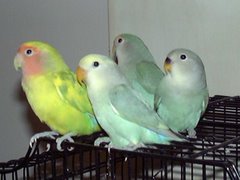
Madagascar lovebirds are scientifically called as Agapornis cana. These lovebirds are native of Malagasy Republic and neighboring islands. Madagascar lovebirds are also called as Grey-headed love bird/Lavender headed love bird.These birds are 13.5 cm long. The male is green in color with silver-gray from head to breast. The females are green from head to breast. Domesticated reared lovebirds of this type are gray from head to breast but of slightly darker shade and covering a smaller area than on adult males; beaks partly blackish.

In wild, the Madagascar lovebirds live in large groups, though remaining in pairs. They usually tend to perch on the fringes of woodland and descend into the rice fields and plantations, where they do great damage.

In the past, Madagascar lovebird were very common and cheap to buy; Nowadays, the Malagasy Republic has banned their export and they become rarities. Newly imported specimens are shy and catch cold easily.

They usually prefer the bird room or family room. In a small cage they are rather nervous and this distract from any pleasure you may have in them. In my experience, they will breed and sleep in a budgerigar nest box by choice.

My birds only used a few sunflower seed husks and two dried leaves as nesting material, but my friends with these breeds reported that their birds used grasses, chickweed, small strips of newspaper, willow bark, pine and larch needles, cranberry and other leaves. They are known for constructing domed nest out of straw.

A clutch almost always consists of four to five eggs, which the female incubates for twenty-two days. Almost five weeks later, the young leave the nest. Young males emerge with a silver-gray head, whereas imported male young ones head is green in color.

Once the young one came out of the nest, it is the male who takes charge of them as the female immediately becomes broody again.

My Madagascar lovebird youngsters were reared almost exclusively on a diet of millet. They over winter in cold weather as long as it remains frost free. Some breeders have suffered no losses when the temperature went as low as -90 c. It is not good idea to house them with another species.
Monday, February 26, 2007

Learn About Madagascar Lovebirds

Zoological Name: Agapornis cana

The Madagascar lovebirds are native of Malagasy Republic and neighboring islands. The male birds are green; silver-gray head to breast, whereas the females are green from head to breast.

Generally the Madagascar lovebirds live in large groups, though remaining in pairs. They tend to perch on the fringes of woodland and descend into the rice fields and plantations, where they do great damage.

In the past, Madagascar lovebirds were very common and cheap to buy. Nowadays, the Malagasy Republic has banned their export and they have become rarities. Newly imported specimens are shy and catch cold easily.

It is best to keep them in the house, in a bird room or family room. In a small cage they are rather nervous and this detracts from any pleasure you may have in them.

In my experience, they will breed and sleep in a Budgerigar nest box by choice. My birds only used a few sunflower seed husks and two dried leaves as nesting materials. But my friends with Madagascar lovebirds have reported that their birds used Cranberry leaves, pine and larch needles, willow bark, small strips of newspapers, chick weed, and grasses. Some of the breeders noticed that the Madagascar lovebirds constructed and nest out of straw.

A clutch almost always consists of four to five eggs, which the female incubates for twenty-two days. After five weeks, the young one emerged out of the eggs. Young males emerge with a silver-gray head.

Once the young have emerged out of the nest it is the male who takes care of them because the female immediately becomes broody again. My Madagascar Lovebirds youngones were reared almost exclusively on a diet of millet. They over winter in the cold weather as long as it remains frost-free. It is not a good idea to house them with another species.