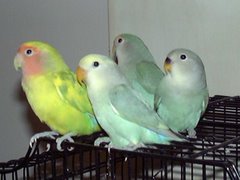
The Lovebirds

The Lovebirds
Perfect Pairs

Thursday, March 6, 2008

What do you Feed For the Peach-faced Lovebirds?

Peach-faced lovebirds are voracious feeders. Give these birds a seed mixture suitable for lovebirds which you can supplement with small amounts of fruit, berries, green food and Italian millet.


During the breeding season, they like to eat small quantities of supplements and egg food and they should also have access to a grit mixture.

In my aviary I feed my birds frozen mixed veggies- any variety is fair. Do serve the vegetables after boiling it in a pot (place the veggies in a pot, bring to a boil) and cool them by running cold water.

Some of the lovebirds owner place broccoli stems in a food processor or cabbage and carrot together- most of the lovebirds love it like anything.

The main prerequisites to make your bird hale and healthy is be patient and do provide your lovebirds a good variety of fresh veggies for at least three weeks or until your lovebird eats the treat.

Even you can use good cockatiel seed mixture with added raw sunflower seeds, 12 grain cereal mix, and wheat germ for the lovebirds feed. Even you can add about 2-3 teaspoons of oyster shells to each batch of seed mixture.

Monday, March 3, 2008

Housing Tips for Peach Faced Lovebirds

Peach-faced lovebirds , which during recent years have become one of the most popular sorts of cage birds, can be kept whether in a cage or an indoor or outdoor aviary. It does not matter much if the cage or aviary is higher than it is long or vice-versa.

However, the cage or aviary must be made of sturdy materials and be resistant to the birds powerful beaks. There is not much point putting plants in the aviary because the lovebirds will gnaw them to pieces in no time.

Peach-faced lovebirds are strong birds which do not require any heating if kept in an outdoor aviary during the winter. However, they should have access to a frost-free night house. You should also provide them with a (roosting) box in which they will use on cold nights.

Friday, February 29, 2008

Social Characteristics of Peach Faced Lovebirds

As you know already peach faced lovebirds are native of Southwest Africa. At first glance, there appears to be no difference between sexes. An experienced breeder can feel the difference between the pelvic bones which are wider apart in the case of the females of the species.

These lovebirds usually get on well together. They occasionally squabble but these confrontations are rarely serious. They can be kept together with other, spirited species of parakeet. Delicate and smaller birds should not be kept in the same aviary or cage.

Single birds can also be kept provided they are given sufficient attention. You can keep two birds, of whatever sex, in a cage in the living room without any problems arising. However, you should never simply introduce a new bird into a cage containing an existing single bird. The new bird will often be regarded as an intruder and will also be treated as such.

It is better to keep both birds in different accommodation or let them get used to each other for quite a long time by placing the cages close together.

Thursday, February 28, 2008

Peach-Faced Lovebirds Breeding

Peach-Faced Lovebirds are quite easy to breed when compared to other species. However, pairing the birds can be quite difficult since the two sexes are very similar. It is best not to try breeding lovebirds younger than a year.

Lovebirds can be called as "pitbull of birds" and for good reason. Generally the hen can show aggression towards on its mate with no warning. You can find one dead bird in the cage once you return from office. Hence getting a suitable pair is really difficult. If you're successful in finding a suitable pair, then you will be rewarded with few clutches of cute little baby lovebirds.

A nest box with a surface area of approximately 10 sq. inches (25 sq. cm) is sufficient. In contrast to most other parakeets, these birds do make nests, usually using coarse twigs that they gnaw into strips.

Between 3 and 5 eggs are laid which the female incubates for between approximately 18 and 20 days. Fledging occurs at least a month or one and a half months after hatching. The very young birds of this species are recognizable due to their partially black beaks. Peach-Faced Lovebirds may well produce a number of clutches per year.

Sunday, February 10, 2008

Lovebirds Need Grit - Dr. Hanson, DVM

One of the visitor to this blog is an avian vet- Dr.Hanson, DVM. He commented about an article on "Need of grit for lovebirds". I have given his opinion as a blog post today. Hope this info will be an eye opener to the pet bird owners.


I have been an avian veterinarian for more than 20 years and the most sad bird problem which I treat is when an owner brings in their dying bird who has not had access to a good quality mineral grit. These people have been badly informed by articles on the Internet and by mis-informed people who write bird owner "help" books. These people have never studied avian physiology.

A bird's ventriculus requires pieces of grit in order to pulverize seeds and fibrous plant leaves. Without grit birds become impacted especially if these poor birds are fed pellets instead of seeds.
Pellets turn into a thick paste in the bird's ventriculus and then blocks the outlet to the intestines (pyloric sphincter obstruction). Insoluble mineral grit combines with the hydrochloric acid in the bird's proventriculus so that a chemical reaction releases electrolytes so that the bird's gastrointestinal tract neurons are stimulated. This prevents proventricular dilatation which is inflammation of a bird's GI tract.

Mineral grit is absolutely essential for all seed-eating birds. Most birds eat seeds. Seeds are the heart of the plant and they provide birds with the necessary energy to fly. It is good that you are telling people about the necessity of grit for ALL seed-eating birds.

It's not true that some seed-eating birds remove the hulls from all of their seeds before ingesting them. This is not true. All seed-eating birds pack their crops with un-hulled seeds before perching for the night so they can have energy in the morning at sunrise. So they do not remove the hulls.

The only time a bird will take the time to remove the hulls from seeds is possibly when it is playing with the seed after it has already ingested sufficient nourishment. It is sad to remove a piece of impacted pellet-paste from a bird's stomach.

Sometimes these birds become so impacted with pellets that they do not have normal stools. The owners are gullible and they have been providing pellets for their unfortunate birds. How sad.

Birds require a species-specific seed and grit diet along with fresh greens and fresh water. Seeds have fat in them and this provides a bird with the extra energy they need. Just because a bird is in a cage doesn't mean its metabolism has slowed-down and shouldn't eat high-fat seeds. The reason birds get liver and kidney failure is due to pellet diets.