The Lovebirds

The Lovebirds
Perfect Pairs

Sunday, July 27, 2008

Woman, Already Married, Takes Macaw as Lover


Just now visited a forum called- "BirdBoard.com/forum". I have found an interesting news there. A woman already married takes MACAW as lover.

You can meet a woman, her husband and a moustache parakeet who are very happy together in this link..

Monday, June 30, 2008

Love Birds - What Does it Take to Care For These Special Pet Birds?

You've probably seen these gorgeous birds in your local pet store. They are the miniature green parrots with the big expressive eyes. Love Birds are a good choice for someone who wants a parrot, but doesn't want the commitment that a large parrot requires. A large parrot such as a Macaw can live for 60 or more years, while a Love Bird seldom lives more than 15 years.

Before you go out to buy a Lovebird, you should be aware of what you're getting into. Lovebirds, like all parrots, are relatively high maintenance pets and therefore require a dedicated and special type of pet owner. Here are some important factors to keep in mind.

Companionship

Love Birds, like all parrots, are extremely social creatures and crave the company of others. If you don't have a few hours to spend with him every day, then you'll need to buy another lovebird to keep him company. Without the companionship of humans or another bird, your bird is likely to exhibit problem behavior such as extreme aggression, excessive preening and constant squawking.

Choosing The Right Lovebird

An ideal lovebird will be 6 to 10 weeks old and hand--fed. A young, hand--fed bird is much easier to tame and train than an older, parent--fed lovebird. The most commonly available species are:

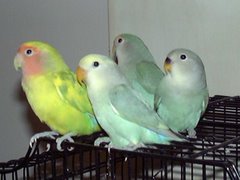
  • Peach Face - This species is usually green, with a peach head, face and neck.
  • Fischer's Lovebird - This bird has a green body with shades of yellow and orange on their head and neck.
  • Masked Lovebird - This bird has a green body, with a dark brown colored brown mask around their face and neck. Just below this mask is a yellow band of feathers.

Housing

Love birds require a large cage with plenty of room to stretch out their wings and play -- obviously a pair will require a larger cage than a single bird. The majority of the cage bars should be horizontal and there needs to be a few perches located at varying levels. Place plenty of toys in their cage to keep them stimulated.

Health

Love Birds require daily exercise to keep them healthy. This means you should let them out to fly every day in a safe room. Make sure there are no open windows or predators (such as dogs or cats) in this room.

You should feed your love bird a quality parrot seed mix and plenty of fresh, clean fruits and vegetables that are bird--safe. This will give them a good variety that matches what they might find in the wild. You'll need to remove any uneaten food every day.
Learn more about Love Birds at http://www.petcarejournal.com/love-birds.html - a website designed to provide you with pet articles and resources that will help you get the most out of your pet keeping experience, no matter what type of pet you own.

Saturday, April 19, 2008

Lovebirds Droppings- The Secrets Revealed

Most of the pet bird lovers are confused with the normal droppings of lovebirds with that of abnormal one. Generally the lovebirds pass watery droppings. As a lovebird owner you should know the constituents of normal droppings.


Lovebird's droppings consist of three separate components including feces, urine and urates. Since the bird pushes the droppings out of one orifice, the vent, all three portions of the droppings are mixed in the cloaca before being passed out of the body.

The Feces


The feces of the lovebirds are solid and worm-like, may be dark green in color. In addition to this, the color of the feces varies mostly what the bird has recently consumed. It can be alarming to the owner if he sees reddish color feces, as this may be interpreted as blood. Hence it is utmost important for the lovebirds breeder to see what their lovebirds are consuming, so that color changes can be correctly evaluated.

If the fecal portion of the droppings is very sticky, tarry, dark, and dark green, then the lovebird doesn't eat any solid food for the past 24 hours. Usually the lovebird breeders often mistaken for digested blood in the droppings, but it is really a kind of bile (biliverdin) from the liver.

The Urine
You can notice the watery droppings in case the feces portion is missing in the droppings, which is an indicative of increase in the urine level. Most of the lovebirds breeders will consider that their bird is passing diarrhea, but it is not so. If the feces is solid with no urine at all, it is not diarrhea.

Missing of brown or green solid fecal portion with watery droppings is an indicative of diarrhea. Some types of diarrhea will show gas bubbles in the droppings, which is an indicative of presence of anerobic bacteria.

Urates

The last part of the lovebirds dropping is urates. It is the end product of protein metabolism in the avian system. This product is filtered in kidney and evacuated in droppings. If your lovebird is showing yellow and green urates, then the avian patients are suffering from liver problem and chlamydophila infection respectively.

As bottom line, the lovebird breeders should aware that when birds consume greens or fruits, it would lead to diarrhea. Some of the breeders are having false opinion about this fact.

Moreover, if your lovebird is nervous, the droppings would be more watery, which is due to high blood pressure than normal.

Any deviation in the lovebirds dropping should brought to the notice of your avian vet immediately to save your valuable lovebirds life.

Thursday, March 6, 2008

What do you Feed For the Peach-faced Lovebirds?

Peach-faced lovebirds are voracious feeders. Give these birds a seed mixture suitable for lovebirds which you can supplement with small amounts of fruit, berries, green food and Italian millet.


During the breeding season, they like to eat small quantities of supplements and egg food and they should also have access to a grit mixture.

In my aviary I feed my birds frozen mixed veggies- any variety is fair. Do serve the vegetables after boiling it in a pot (place the veggies in a pot, bring to a boil) and cool them by running cold water.

Some of the lovebirds owner place broccoli stems in a food processor or cabbage and carrot together- most of the lovebirds love it like anything.

The main prerequisites to make your bird hale and healthy is be patient and do provide your lovebirds a good variety of fresh veggies for at least three weeks or until your lovebird eats the treat.

Even you can use good cockatiel seed mixture with added raw sunflower seeds, 12 grain cereal mix, and wheat germ for the lovebirds feed. Even you can add about 2-3 teaspoons of oyster shells to each batch of seed mixture.

Monday, March 3, 2008

Housing Tips for Peach Faced Lovebirds

Peach-faced lovebirds , which during recent years have become one of the most popular sorts of cage birds, can be kept whether in a cage or an indoor or outdoor aviary. It does not matter much if the cage or aviary is higher than it is long or vice-versa.

However, the cage or aviary must be made of sturdy materials and be resistant to the birds powerful beaks. There is not much point putting plants in the aviary because the lovebirds will gnaw them to pieces in no time.

Peach-faced lovebirds are strong birds which do not require any heating if kept in an outdoor aviary during the winter. However, they should have access to a frost-free night house. You should also provide them with a (roosting) box in which they will use on cold nights.