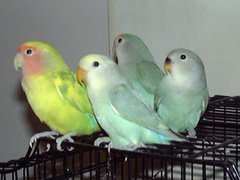
The Lovebirds

The Lovebirds
Perfect Pairs

Tuesday, August 31, 2010

Giardia Infection in Lovebirds

Lovebirds can't escape from this dreadful disease of Giardiasis.This can also be classified into Zoonotic Diseases in Lovebirds.

The main symptom of this disease in your lovebird is feather plucking. Once you noticed feather plucking, you should immediately seek an appointment from an Avian vet. The stools of the lovebird should be examined thoroughly to rule out the infection of giardiasis.

Other symptoms
  • Depression
  • Anorexia and weight loss
  • Lethargy
  • PICA
  • Acute chronic or recurrent diarrhea
  • Scratching in flank and legs
Treatment
  • Oregano - an European herb used to treat this condition by sprinkle on your food each day or follow package directions
  • Anti- protozoal drug therapy
Prevention

Remove water bowl frequently and clean the same immediately.sundry the water bowl daily to avoid reinfection. If possible train your lovebird to drink water from water bottle inside the cage.

Saturday, July 31, 2010

Can you keep other birds with your lovebirds?

Most of the bird lovers like to know answer for this query. The answer is "Yes" and"No". Am I confusing you? Please go on reading to find answer for this query.

In general, the love birds are timid, but aggressive and should not be housed with other types of birds. But I am having an experience of housing a Zebra Finch and a Lovebird because I hand fed them together right from their childhood. But I had a bitter experience when a lovebird that shares a cage with a Green Cheek Conure because both of them are more aggressive and fought among themselves. I mixed up them when they are adult.

The conclusion is that the best thing is you can mix different species right from the day old. when you mixed up the adult one, you will end up in problem.

Sunday, February 28, 2010

Lovebirds Day Out...


When your lovebirds escaped out of cage, what will you do? It happened yesterday. A pair of lovebirds from my cage escaped out and sat in the tree in my garden. I managed to capture them back by placing its favorite food in the cage. As I have trained them, within no time, both of them are in cage. So lovebirds training is more important. Now only I have learned the advantages of lovebirds training.

Although you can't train your lovebird like dogs, you can try simple ways to obey your words. I have discussed this in my blog- How to train lovebirds? Do search and get to know about the lovebirds training technique. Training is an important part in lovebirds care. All the best!!!

Sunday, January 31, 2010

How the cages of Peach faced lovebird should be?

Recently, I heard that some of the peach faced lovebirds escaped form captivity and forms large feral populations in Arizona and London. So I decided to write about the cages necessary for the captive peach faced lovebirds.


In wild, they will often gather in small groups and are highly sociable bird. In wild, they will take feed through out the day and frequent baths. so if you're going to build a cage for your lovebird, please stick on to the following criterion-

1. A cage of 2'x2'x2' is more than sufficient for a single peach faced lovebird.

2. Do select the cage with bars quite close together. In reality the lovebirds are the Harry Houdinis in the world of birds and can squeeze out of many cages where other birds cannot.

3.Unlike other birds, lovebirds will try to pick the locks frequently, so check the door latches for proper security.

4. The wooden cages for lovebirds arenot all suitable because they're notorious chewers. If you own a wooden cage already, you must have one be ready to replace it as soon as possible.

5. The cage should have a small perch as the birds in order to avoid arthritis, which are prone to peach faced lovebirds.

Thursday, December 31, 2009

Lovebirds Conjuctivitis

Do you know there is 30% mortality among lovebirds due to conjuctivitis? (Source:Science direct) So it is mandatory get to know about the disease conjuctivitis in lovebirds. The main symptoms of conjuctivitis in lovebirds include lacrimation, whitish thick mass at the corner of the eye, anorexia and ruffled feathers. In severe cases, red, swollen, watery, or crusty eyes; sometimes the eyes are so swollen or crusted over that the birds.

Causes for Lovebird Conjunctivitis

The main causative factors for this condition includes protozoa, nematodes, fungi, bacteria and injuries. You can confirm the cause for the conjunctivitis only by performing diagnostic tests.

How To Cure?

Don't go for any natural remedies to cure this disease in lovebirds because Chances are the bird would be dead before they could take effect. Enrofloxacin, Doxycyclin, or erythromycin are the best drug of choice for treating this condition. But consulting an avian vet to treat your lovebirds is highly recommended.

After giving antibiotics it is always being advised to give after any antibiotic treatment for control lovebirds conjunctivitis.