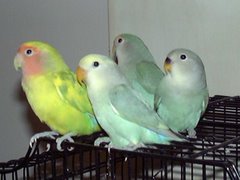
The Lovebirds

The Lovebirds
Perfect Pairs
Showing posts with label African lovebirds. Show all posts

Sunday, October 9, 2011

What is the best food to feed love birds?

Of late, more and more people are going for love birds to have them as their pet. These lovely little creatures are very cute looking and intelligent hence are adored by one and all. These love birds are excellent stress busters. These birds can perform many tricks and enthral the audience if trained properly. Most of the pet owners are not aware what the best food for these cute little creatures is. Let us discuss about that in this article.


The food provided should be preferred by the love birds. Seed mix of good quality is what is required for the love birds. Budgie seed added with white sunflower, mung beans, hemp, groats is the best for the cold weather. Love birds can also be provided with fresh good quality fruits such as mango, apple, grapes, pears etc and vegetables such as broccoli, pak chio, kale, sweet corn cob etc. love birds can also be provided young bamboo leaves.

The love birds enjoy soaked sprouting seed. The above mentioned seeds can be soaked in warm water. The mixture can be kept as it is over night and allowed to drain. Then the same is placed in warmth till it sprouts. Generally it takes 2 -3 days for sprouting. This sprout should be rinsed once again before feeding the love birds. This sprout is not mere a food but an excellent tonic for the love birds.

The love birds require sufficient minerals for the health of the birds. Hence provide cuttle bones as they are natural source of minerals. Mineral blocks are available in the pet stores and always have them ready for usage. If one follows diligently the details provided in this article, the love birds of theirs will be always at brim of health and the colour of the love birds will be as attractive as ever.

Thursday, April 28, 2011

Lovebirds Microchipping

Microchipping provides a permanent and unique way of identifying a lovebird. The microchip can be inserted into the pectoral muscle tissue of birds.

The only advantage of using band than microchips is that the microchips are relatively expensive, and placing them into birds requires technical skill, but their use has proved successful in birds identification. Microchipping lovebirds is helpful in identifying them, which will provide necessary information like breeding, feeding of lovebirds to the lovebird owners. One step further, this technology is useful in wildlife conservation and field study programmes.

Will the lovebird bleed?

Birds won't bleed when you microchip them. If you notice a hole left by the needle at the insertion point, this can be repaired by tissue glue or suture.

Read more about

Microchipping - a Perfect method for lovebird Identification

Sunday, June 21, 2009

Tips For Traveling With Lovebirds


Lovebirds
are one of the most difficult birds for a person to bring with them on a trip because they are very easily startled. If you want to travel by air, they don't necessarily work well. Traveling will definitely made the lovebirds more excited and also sparks their curiosity. Even some of the lovebirds suffer from separation anxiety.

You can make the traveling with lovebirds more easy, if you follow the simple tips discussed below-

You should know the daily routine of the bird and if they have the same pattern while traveling, you need not worry. If you are carrying young birds, then it is very easy task because they can adjust easily for the change in surroundings. But the adult birds would have a certain pattern of living, which they don't want to change.

You should ask yourself the following questions before start of your journey-
  • Is it legal to traveling with lovebirds into the state or country?
  • Upon arrival, when will I have time for them?
  • How much time they will feel comfortable within the cage?
If you get answers for these questions, your trip won't get ruined by the lovebirds. An important step to be carried out with your lovebird is vaccinate the bird against any dreadful diseases prevailing in the area of visit. Happy Journey!!!

Friday, December 19, 2008

Common Lovebird behaviors

Most of the owners think that lovebirds should be kept in pairs. It is untrue! In fact single lovebirds often make the best pets.

As a owner you should know about the meanings for each and every behavior of your lovebirds.

The common behaviors observed in lovebirds are Beak Grinding, blinking, wing flopping, head bobbing, head bowing, Paper shredding and tucking, puffed feathers, tail rubbing, head on back, body couched, wing spread.

If you notice any of these behaviors, you should know what your lovebird is telling you. I'll discuss in detail what it means in the ensuing days.

Sunday, August 31, 2008

What Kind of Perches are Better for Lovebirds?

Perches for lovebirds are an important criteria for making them happy (???) in the cage. The girth of the perch should be more than the diameter of the lovebirds wrapped feet. i.e. the lovebirds foot does not wrap completely around the perch. This is an important criteria in selecting perches for your lovebirds. There are two types of perches available for lovebirds viz., natural perches and cement perches.


Natural Perches

If you want to provide comfort to your lovebird, then natural perches are the best not only for resting but also for chewing. The normal behavior of the lovebirds is removing bark and demolishes the perches. So you need to replace the perch regularly.

While selecting natural perch from trees, you should be careful that the branch should be devoid from pesticides or insecticides. Any how, it is better enough to clean the perch material with 10% bleach solution.

The natural perches for your lovebirds include willow, poplar, pine, manzanita, mulberry, fir, elm, dogwood, crabapple, cottonwood, cactus wood, birch, beech, ash, and apple.

Cement Perches

Some of the lovebirds owner prefer cement perches, which helps in trimming their nails. As these perches are very hard, place them in the place where your lovebird goes everywhere but spent not much of time.

The ideal place for placing these cement perches are just in front of food and water dishes. You will have to clean these lovebirds perches frequently as they use these as an area to wipe its beak. The optimal size of th cement perches would be in such a way that the foot ought to go 3/4 of the way around the perch.

Lovebirds perches are really an important thing to be selected with utmost care to avoid bumble foot and beak disorder(pecking). So perfect perches for your lovebird will definitely help to keep them hale and healthy.

Monday, March 3, 2008

Housing Tips for Peach Faced Lovebirds

Peach-faced lovebirds , which during recent years have become one of the most popular sorts of cage birds, can be kept whether in a cage or an indoor or outdoor aviary. It does not matter much if the cage or aviary is higher than it is long or vice-versa.

However, the cage or aviary must be made of sturdy materials and be resistant to the birds powerful beaks. There is not much point putting plants in the aviary because the lovebirds will gnaw them to pieces in no time.

Peach-faced lovebirds are strong birds which do not require any heating if kept in an outdoor aviary during the winter. However, they should have access to a frost-free night house. You should also provide them with a (roosting) box in which they will use on cold nights.

Monday, May 7, 2007

General Management of African Lovebirds

African lovebirds are a group of parrots with short squaretails. They all come from Africa. Their main coloring is green with some orange and yellow feathers in the tail. The head coloring varies with the species of which there are quite a few.

African lovebirds thrive on a seed mixture of equal parts millet, canary, with a very little sunflower and hemp. They like green food and apple. They breed in a nest boxes which should be about twice the size of a budgerigar's nest box: 8 by 8 by 8 inches is quite a good size with an entrance hole just big enough for them to get in and out, high up in one side.

Unlike most members of the parrot family, African lovebirds build nests inside their boxes consisting mainly of long thin strips of bark peeled from twiggy branches. They have a unique method of carrying this to the nest box by sticking several strips of bark into the feathers on their rumps and conveying them to the boxes in this manner.

African lovebirds are free breeders in aviaries, the only snag being that, with certain exceptions, they are almost impossible to sex. Various theories have been advanced on how to tell cocks from hens, such as size of head, shape of beak, width between pelvic bones and so on, but whilst these hold good in some cases none of these methods is really reliable.

If you have two lovebirds, which go to nest and never produce eggs you can safely assume that you have two cocks. Conversely, if they produce what appears to be abnormally large clutches of infertile eggs you can be pretty sure that you have two hens.

African lovebirds enjoy a bath so they should regularly be provided with a shallow dish of clean water in which to indulge this habit.

Tame single specimens make good pets although they are unlikely to learn to talk. Pairs usually remain wrapped up in themselves talking little or no interest in their human companions. African lovebirds are usually better kept in out-door aviaries where their bright colors and amusing habits may be enjoyed to greater advantage.