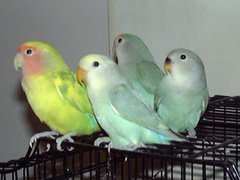
The Lovebirds

The Lovebirds
Perfect Pairs
Showing posts with label lovebirds. Show all posts

Wednesday, January 14, 2026

Abyssinian Lovebird: A Complete Guide for Bird Lovers

 The Abyssinian lovebird (Agapornis taranta), also known as the black-winged lovebird, is one of the most striking members of the lovebird family. If you're searching for Abyssinian lovebird info, you have landed in a right page. Thanks to Google!!! So let's dive right in and get to know this gorgeous bird a little better. Native to the highlands of Ethiopia and Eritrea, this species really stands out with its rich green plumage, contrasting black flight feathers, and a bright red patch on the forehead of the males. And unlike many other lovebird species commonly kept as pets, the Abyssinian lovebird is on the larger side too, typically measuring around 16 cm, making it one of the biggest birds in the Agapornis genus.


Appearance and Identification

Spotting a mature Abyssinian lovebird male is pretty easy once you know what to look for — that scarlet forehead band, dark eye ring, and coral-red beak set against deep green body feathers give it away instantly. Females, interestingly, don't have the red forehead marking, so telling males and females apart is much simpler here than with most lovebirds. Keep an eye out for a subtle black tint on the wings during flight too — that's exactly where the bird gets its alternate name from.

Habitat and Natural Behaviour

In the wild, you'll find the Abyssinian lovebird tucked away in highland forests and juniper woodlands, usually at elevations above 1,500 meters. They like to hang around in small flocks, feasting on wild figs, seeds, and berries. One thing bird keepers really appreciate about this species is its quieter, more reserved temperament compared to other lovebirds — perfect if you're after a calmer feathered companion.

Care Tips for Bird Keepers

Thinking of keeping one? Give your Abyssinian lovebird a spacious enclosure since it's a bigger bird, and don't skimp on the diet — fresh fruits, vegetables, and a good quality seed mix go a long way. They're not bred in captivity as often as peach-faced or masked lovebirds, so it's worth taking the time to find a healthy, well-adjusted bird from a reputable breeder. And don't forget the fun stuff — regular social interaction, toys, and foraging activities all help keep your bird happy and engaged.

Why Choose an Abyssinian Lovebird?

If you're after something a little different — a lovebird with striking looks, a gentle nature, and real rarity value — the Abyssinian lovebird ticks every box. Give it the care it deserves, and this beautiful bird will thrive, whether in an aviary or as a treasured companion at home.

Wednesday, February 1, 2012

Understanding Lovebirds Care


The love birds are affectionate pet. As these birds are very small, these birds can be maintained with ease. You won’t be requiring more space to have them in house. Love birds are very tough birds and are resistant to many diseases that threaten the larger parrots and cockatiels. These love birds are welcome in any house as these birds are cheerful and have gorgeous coloring. Love birds are good breeders and the breeding is very simple without much complication.

The love birds are easy to care. But it is the duty of the pet owner to get the much needed details about the birds from the breeder. The breeder should spell out the health guarantees and the kind of feed required for that particular type of love bird. The seed feeding should be avoided as much as possible. Formulated diets such as Hagen tropican granules are considered best as they contain vitamins and minerals that are required for the birds. It is hard to balance the diet with seeds as love birds are fussy eaters. The love birds can be fed fruits, fresh greens and vegetables. These food stuffs can be chopped and fed to the love birds. The wet food should be removed as and when noticed in order to avoid spoilage. Fresh corn is the most favorite food for most of the love birds.

The love birds should be taken to the avian specialist within the first week of the purchase. The vet will test the birds for psittacosis. Psittacosis can be transmitted to human beings too and hence one should be careful about it. The good news is that psittacosis is not common in love birds.

The numbers of love birds that can be purchased totally depend on the pet owner. There is no restriction on the numbers love birds to be kept as pet. If the owner has the time, money, space in the house, he or she can go in for any number of love birds. In general people buy the love birds in pairs as they can be bred in future. Besides the love birds will be happy with a partner. Identifying the sex is not all that easy in love birds as both male and female resemble closely. The pet retailer should provide the information about the sex of the love birds.

The new arrival should be kept in separate cage for a period of 30 days in case there were birds already in the house. The new arrival should be provided clean cage in the quite corner of the house.

Thursday, January 12, 2012

What to Feed my Lovebirds?


Lovebirds are such a wonderful creature and there is hardly anybody who does not love these tiny birds. These birds as the name suggest love to remain in pairs. These lovebirds spend hours together sitting side by side to its partner.

These birds are in fact smaller version of parrots. They grow to the size of 5 inches and can live for 15 years. Though these lovebirds are small, there is no shortage of activity and noise level. Many like to have these lovely creatures at home as pet. But most f them are not aware what to be fed to them. Here is little information about the feed for lovebirds.

The lovebirds like to feed on fresh and organic foods as they want to live close to the nature as much as possible. The love bird’s food can be pellets of fruits, vegetables and seeds. In wild the lovebirds mainly feed on seeds.

The parrots love to have variety of foods instead of feeding on the same food. Hence one should change the feed every day as there is a lot to be added in the food list such as cooked beans, pasta, fresh grains, brown rice, sprout, wheat grass, non toxic flowers etc.

There are many different verities of lovebirds right from red head to black collar and each species will have different liking when it comes to food. One should be aware of this fact. The black collared lovebirds are fond of fig fruit.

The food provided can be in the form of pellets or the food can be provided by soaking the same in water in order to soften the food. The food that is soft will be digested easily by the lovebirds. The water dish provided must be very clean. The water provided to the love bird should be free from contamination. The water bowls should be cleaned every day in order to avoid bacteria build up.

As discussed earlier, raw fruits and vegetables are good for the health of the lovebirds. But some birds will be very choosy about their food and such lovebirds are to be cared more and their specific requirement should be met with.

One has to be careful while providing the cooked food to the lovebirds. The cooked food should be allowed to cool before feeding. For example the cooked potato will be very hot and if provided as it is before cooling, the poor creature will get its beak damaged and at times the birds may die if the digestive system is damaged too badly. The food that was not consumed by the love bird for more than 24 hours should be removed from the cage and should be thrown out in the dust bin. There should not be any re heating and re using.

The lovebirds are very active and social animals. These birds are likely to slip in to boredom if not properly engaged. The boredom will lead to feather plucking, biting and screaming. One should aim at providing interactive way of feeding the lovebirds. Using food finding toys in case of pellets and skewers in case of fresh foods are recommended to keep the lovebirds in good spirit and to chase the boredom.

Sunday, January 8, 2012

Lovebirds Behaviour & Interaction


The love birds are lovely creatures to be kept as pet at home. One requires this kind of pet to get relieved from the tension of day to day life. People prefer Love birds as they are very easy to maintain and the expense incurred is very less compared to the other animals like dog, cat etc. all one require is the little time to spend with these little creatures in order to chase out the boredom they get in to if not attended by the any one of the family members.

As we all know the love birds are very social animal and long for affection and attention all the times. Love birds in wild live in large flocks. Love birds can learn word and phrases very well though they are said to be not good when it comes to mimicking.

Love birds require different types of toys that are chewable. Love birds also enjoy puzzle toys that challenge the birds. The love birds are very quick in learning the tricks and words. The love birds are very friendly and love to assist the family be it small or large. The love birds will more favour the person in the family who spends more time with them. The bite of the love is small and the noise level is less. As the result these birds are highly suitable for apartments.

Habitat maintenance – the love bird’s cage should be changed at least one time in a week. The cleaning and the disinfection of the cage should be done as much as possible. The love bird’s weight should be monitored on daily basis which will help one to identify whether the birds are ill or not. The love birds are very good at disguising the illness; hence it is difficult to find out if the love birds are ill.

Thursday, August 25, 2011

Love Birds Training

Training love bird is not so difficult like the training of the dog. With love and patience the love birds can be trained with ease. Reward system works well for the love bird training. But the fact of the matter is most people just buy these love birds with no knowledge of training and caring these lovely creatures.

Providing proper feed and protecting the love birds from other dangers is not enough. The love birds can be trained to wave, spin and to make basket. The training should be first attempted on eliminating the undesired habits if there is any. Along with this, one can train the love birds to learn fun tricks. This way the boredom of the bird is chased away and the bond between the owner and bird becomes stronger. By this the bird will be happy, so also the owner. Sounds great is it not?

Learning the training trick is very easy now a day. Of course there are so many training manuals available. But those are out dated now. Technology is so developed and video tapes are available in the market which teaches the owner how to go about the love bird training. Some of the video tapes are so real that they actually train is untrained love bird and record the same and sell it in the market. There literally unmanageable bird is getting trained in front of your eyes. All one has to do is just to follow the same with your lovely love birds.

If trained properly the love birds will start behaving smartly and the vices are totally removed and the love bird and the owner can live in harmony. While training the love bird the owner will be spending lot of time with the bird. This way the owner will earn the trust and love of the birds. The chemistry and the bond will be strengthened. The quality time spent on the bird will certainly improve the health of the owner by reducing the stress level.

Once you are thorough with the training procedure of love bird, you can practice the same with your subsequent purchases and get the desired result so quickly. Very shortly you can also think of releasing a video tape in the market about love bird training. Nothing wrong in earning some money out of it and the same can be used for future purchase of love birds.

One can be very sure that training lover birds in incredibly satisfying. The bird will come to you and sit in your finger and do what ever you want them to do. One can not have better feeling than this. The love birds will what all they know to amuse you as they will just love you so much for the quality time spent on them? The kids in the house will enjoy all this with amusement. It will be great joy for the entire family, is it not? The experienced trainer can think of starting the breeding of the love birds too.

Saturday, July 31, 2010

Can you keep other birds with your lovebirds?

Most of the bird lovers like to know answer for this query. The answer is "Yes" and"No". Am I confusing you? Please go on reading to find answer for this query.

In general, the love birds are timid, but aggressive and should not be housed with other types of birds. But I am having an experience of housing a Zebra Finch and a Lovebird because I hand fed them together right from their childhood. But I had a bitter experience when a lovebird that shares a cage with a Green Cheek Conure because both of them are more aggressive and fought among themselves. I mixed up them when they are adult.

The conclusion is that the best thing is you can mix different species right from the day old. when you mixed up the adult one, you will end up in problem.

Sunday, February 28, 2010

Lovebirds Day Out...


When your lovebirds escaped out of cage, what will you do? It happened yesterday. A pair of lovebirds from my cage escaped out and sat in the tree in my garden. I managed to capture them back by placing its favorite food in the cage. As I have trained them, within no time, both of them are in cage. So lovebirds training is more important. Now only I have learned the advantages of lovebirds training.

Although you can't train your lovebird like dogs, you can try simple ways to obey your words. I have discussed this in my blog- How to train lovebirds? Do search and get to know about the lovebirds training technique. Training is an important part in lovebirds care. All the best!!!

Monday, November 9, 2009

How To Control Feather Plucking in Lovebirds?


Have you ever noticed few missing feathers in the crests of wings or breasts of your lovebirds? Then, you should keenly watch your lovebirds for feather plucking. Although this falls under behavior and health, you should be carefully analyze the reason for feather plucking in lovebirds.

Initially feather plucking might have started innocently. But you should nib this problem in the bud itself. Otherwise it will cause your lovebirds complete bald. Then it is really difficult to bring back the colored feathers.

Feather picking among breeding pairs is a common phenomena. A hen lovebird will often clear few hairs on her belly, which is called as brood spot and also pluck few feathers from her mate's head as a mark of mating behavior among themselves.

The other reason for feather picking is hormonal issue. Lovebird pyoderma is the condition which occurs due to hormonal imbalance. If you're having a single lovebird, this is a major problem because it has no outlet for his/her energies.

Rule out the skin infection by examining the skin scraping on microscope. If they suffer from any skin infection- bacteria or fungus, immediately contact your avian veternarian to treat the condition.
Anxiety, frustration and boredom may also lead to feather plucking in lovebirds. There was lovebird which started to pluck its feather after fixing a photograph just in front of her cage. Removing the photograph solved the problem. Who knows what made that poor creature to get more anxious after seeing that particular photograph.

Treatment

Find out the cause for the feather plucking and remove the same at the earliest possible time. Don't use styptic powder in the wound as it would aggravate the condition. Do use diluted betadine solution to clean the wound. More over, don't treat the lovebird on your own. Please do seek an appointment form your avian vet to completely get rid of this problem. ALL THE BEST!!!

Friday, July 31, 2009

Advantages of training Lovebirds

"What the advantages lovebirds have over the larger species of parrot especially in case of lovebirds training?" is the question asked by most of the lovebird breeders. As the lovebirds are small and easy to handle, they can be trained at all ages.

You should tame your lovebird before giving training to the same.

Lovebirds are cute and highly sociable bird. It is easy to train a lovebird because-

1. They are so intelligent

2. Handling them to train is so easy.

You can train the lovebirds to learn different techniques such as perching on your hand, to perform different tricks and to talk also.

Whether your lovebird is a squawker? Don't worry! You should find out the reason why your lovebird is squawking. He/she may be disturbed by anything including a fly or T.V., get bored, or want your attention. If you want to control this act of squawking, you should ask him/her- "What's all the noise for?, Wanna play with me?, What are you doing?" in an excited and happy tone. That's all!!! Your lovebird will be more happy and immediately stop squawking. This simple training of lovebirds will help you to build more confidence on you.

Happy Training!!!

Saturday, January 24, 2009

Lovebirds- Are they really Lovable?

I love my lovebirds like anything. In spite of my initial problems with these birds, I didn't get any problem from these lovable creatures. I am going to discus about the problems encountered with my lovebirds while I have started to rear.

Once upon a time, I was a disgruntled lovebird owner because I bought my hand-fed baby lovebird from a pet store and that poor creature had bitten my fingers. Moreover, it was acting in such a way that it was going to be murdered when I finally caught it and also refuses to come out of the cage. These worst habits of a lovebird made me to think twice- Is it necessary to rear this bird? Moreover I was in an undeserved reputation about these unfriendly wild parrots.

I researched a lot to made my lovable lovebirds really lovely one. I read that lovebirds purchased from pet stores will behave like this only because these pet stores won't concentrate on these tiny creatures when they are housing both large parrots and tiny lovebirds. Once lovebirds haven't got human interaction at least for a week, then they would become as a wild.

Initially I didn't loose my heart. I spoke daily with this tiny lovebird. I spent nearly 30 minutes to speak with this fella morning and evening. It became normal within 15 days. Now I will finish my breakfast with my lovebirds in my shoulder.

The lesson I learnt is - "lovebird babies need to be stroked, talked to, played with, and reassured. These babies will make the best pets." So don't worry!!! You also adore your lovebirds within couple of weeks, if you have bought the same just few days back. Don't loose your heart and think that you have selected a worst pet in the world. ALL THE BEST!!!

Monday, December 22, 2008

Why Your Lovebird Is Shredding Paper and Tucking?


Most of the newbie lovebird owners don't know the reason why their lovebirds shreds paper and tucking. In general lovebirds think that they are born with an objective to shred and take every opportunity to do so. Some times, you can notice that the females will often tuck strips of shredded paper in their rump feathers. In some flock, males will also tuck the shredded paper but they're not so good in carrying the shredded paper. Both these lovebirds are carrying the shredded paper mainly with an intention to strengthen their nest by carrying more nesting material back to the nest.

Saturday, December 20, 2008

Reasons for Beak Grinding in Lovebirds


Most of the lovebirds do grind their beaks daily. This made some of the lovebird owners to get worry about this act. Do you know why birdies do this? They will grind their beaks before going to sleep. The sound of beak grinding would be like the nails down a chalkboard thing.

Some of the lovebirds owner think this behavior is method of calming down. It is true! Moreover, your bird is grinding the beak as a sign of happy and contentment.

Sometimes the lovebirds will grind their beak as well as squinting, which mean your bird is tired, but happy.

Grinding beak also conditions lovebirds beak. This act of beak grinding behavior is similar to that of a kid sucking their thumb. Although it's a weird grating sound, it is an act of self-stimulation behavior. If you're having more than three lovebirds, it is really hard to figure out which one does that.

Let's you know your lovebirds are happy, and keeps their beaks in good shape by grinding them in a perfect manner.

Saturday, November 29, 2008

Toxoplasmosis in Lovebirds


Do you know lovebirds are prone to Toxoplasmosis? Toxoplasmosis is a disease of zoonotic importance. Although toxoplasmosis is more confined to cats, lovebirds are also affected by Toxoplasmosis.

Toxoplasmosis is caused by a protozoan parasite- Toxoplasma gondi. Drinking water contaminated with Toxoplasma is the usual entry of the organism in lovebirds.

Toxoplasma infection has two stages- Acute Toxoplasmosis and Latent Toxoplasmosis. Most infected lovebirds have no symptoms and are never diagnosed. The affected birds will have swollen eyelids with nasal discharge.

In humans, the affected individuals will show muscle weakness, eye damage, and abortion in pregnant women. So it is always advisable to avoid handling of lovebirds during pregnancy period of a woman.

Usually the diagnosis of the disease can be confirmed by polymerase chain reaction (PCR). This is the confirmative test for Toxoplasmosis in lovebirds.

The common medicines employed to control toxoplasmosis in lovebirds include clindamycin, spiramycin, etc. In the latent toxoplasmosis, the common drug of choice is atovaquone. It is always advisable to prevent the occurrence of this disease among lovebirds than curing the same.

Friday, November 21, 2008

Psittacosis in Lovebirds


Psittacosis is a disease of parrot family. Lovebirds are also commonly affected by this disease. Moreover this disease would spread to other human beings also, if the lovebirds with psittacosis is being stressed too much. Thats why Psittacosis is considered as one of the Significant Zoonotic Diseases of Lovebirds

Other factors that predisposes Psittacosis include poor quality of feed, overcrowding and other infections of the lovebird. If you want to prevent this disease among lovebirds, you need to follow sensible hygiene as well as proper feeding.

Regular cleaning of the cage to remove fallen feathers and droppings will help to check this disease. This disease will spread through the dust. while cleaning the lovebirds cage, it is mandatory to wear a mask and hand gloves to prevent exposure to this dreadful disease.

Symptoms

The common symptoms of Psittacosis are-
  • Conjuctivitis
  • Discharges from eyes and nostrils
  • Diarrhea
  • Weight Loss
Treatment

If you have discovered the disease in early stages, it is really possible to get rid of Psittacosis provided the lovebird should not suffer from any other underlying disease. You should quarantine the sick birds immediately. Keep in mind that only the sick birds need not to be treated, but rest of the lovebirds in the cage should be given suitable treatment.

Usually Tetracycline group of antibiotics are found to be very useful in containing this disease. Disinfect the cage using disinfectants like Glutaraldehyde, etc.

Last not to be least, do love your lovebirds, but don't kiss them to get exposed to Psittacosis.

Tuesday, September 30, 2008

Microchipping - a Perfect method for lovebird Identification

Most of the lovebirds owners find difficult to identify each and every bird, if they are maintaining more than 10 birds of same variety and color. Hence it is mandatory to do microchipping of your lovebirds.


This method is helpful to identify your lovebird in case of escape or loss. Your avian vet will inject a custom microchip under the skin. Microchipping is the safe method of lovebirds identification. Within few seconds, your vet can implant the microchip under the skin of the lovebird.

Why Microchipping?

This is the only permanent way to prove that the lovebird is yours in case of theft or escape. This is the safest method of bird identification with no stress on the bird. In addition, it can be implanted within the bird without undue stress to the same. But with a microchip you can prove the bird is yours.

Advantages

This micro chip never move within the body. Earlier chips are having problem of migration which causes stress for the birds. This chip is of rice grain in shape and encourage to form a scar tissue around it, thus anchoring them into place. The chip has an average life of around 25+ years

AVID and HomeAgain are the two companies that made microchipping for lovebirds. AVID providing common scanners used in pet birds.

So, do microchip your lovebirds to get identified easily. ALL THE BEST!!!


Monday, August 18, 2008

How Lovebirds Fly in the Rain without Hurting Their Eyes?

Do you know answer for this question? If so, please don't read further. As other birds, lovebirds have a special third eyelid, called the nicitating membrane, under their regular eyelids.

It is transparent like motorists goggles on their eyes. It is drawn across the eye to moisten or clean it while flying. Many ornithologists believe the nictitans is held over the eye most or all of the time a lovebird is in the air.

The nicitating membrane in the lovebirds eye protects against collisions when birds are crashing through bushes. The birds of prey especially peregrine falcon knows very well about this membrane- thats why they closes the eyes of the prey immediately after grabbing their prey before the impact of the nicitating membrane.

One step further, Swifts (fastest flying bird) have been widely believed to be able to sleep while flying, although this has not been proved experimentally. Any how scientists believe this fact. But lovebirds never sleep while flying.

Saturday, August 16, 2008

Will Lovebirds Enjoy Showers?


Have you ever asked this question - Where are All the Lovebirds When It Rains? They will usually huddle under the leaves of shrubs and trees.

Many places, though, provide no shelter. Consequently, birds have their own rain-evolved feathers. Birds stay relatively dry and warm under these feather.

Still, birds get wet. Most of the birds don't mind to stay in the rain, if they don't find hiding place. After the rain they fluff up their feathers to warm up and help themselves dry off. After a dry spell, even with trees galore, they sit sometimes out in the rain and enjoy showers.

Saturday, April 19, 2008

Lovebirds Droppings- The Secrets Revealed

Most of the pet bird lovers are confused with the normal droppings of lovebirds with that of abnormal one. Generally the lovebirds pass watery droppings. As a lovebird owner you should know the constituents of normal droppings.


Lovebird's droppings consist of three separate components including feces, urine and urates. Since the bird pushes the droppings out of one orifice, the vent, all three portions of the droppings are mixed in the cloaca before being passed out of the body.

The Feces


The feces of the lovebirds are solid and worm-like, may be dark green in color. In addition to this, the color of the feces varies mostly what the bird has recently consumed. It can be alarming to the owner if he sees reddish color feces, as this may be interpreted as blood. Hence it is utmost important for the lovebirds breeder to see what their lovebirds are consuming, so that color changes can be correctly evaluated.

If the fecal portion of the droppings is very sticky, tarry, dark, and dark green, then the lovebird doesn't eat any solid food for the past 24 hours. Usually the lovebird breeders often mistaken for digested blood in the droppings, but it is really a kind of bile (biliverdin) from the liver.

The Urine
You can notice the watery droppings in case the feces portion is missing in the droppings, which is an indicative of increase in the urine level. Most of the lovebirds breeders will consider that their bird is passing diarrhea, but it is not so. If the feces is solid with no urine at all, it is not diarrhea.

Missing of brown or green solid fecal portion with watery droppings is an indicative of diarrhea. Some types of diarrhea will show gas bubbles in the droppings, which is an indicative of presence of anerobic bacteria.

Urates

The last part of the lovebirds dropping is urates. It is the end product of protein metabolism in the avian system. This product is filtered in kidney and evacuated in droppings. If your lovebird is showing yellow and green urates, then the avian patients are suffering from liver problem and chlamydophila infection respectively.

As bottom line, the lovebird breeders should aware that when birds consume greens or fruits, it would lead to diarrhea. Some of the breeders are having false opinion about this fact.

Moreover, if your lovebird is nervous, the droppings would be more watery, which is due to high blood pressure than normal.

Any deviation in the lovebirds dropping should brought to the notice of your avian vet immediately to save your valuable lovebirds life.

Friday, February 29, 2008

Social Characteristics of Peach Faced Lovebirds

As you know already peach faced lovebirds are native of Southwest Africa. At first glance, there appears to be no difference between sexes. An experienced breeder can feel the difference between the pelvic bones which are wider apart in the case of the females of the species.

These lovebirds usually get on well together. They occasionally squabble but these confrontations are rarely serious. They can be kept together with other, spirited species of parakeet. Delicate and smaller birds should not be kept in the same aviary or cage.

Single birds can also be kept provided they are given sufficient attention. You can keep two birds, of whatever sex, in a cage in the living room without any problems arising. However, you should never simply introduce a new bird into a cage containing an existing single bird. The new bird will often be regarded as an intruder and will also be treated as such.

It is better to keep both birds in different accommodation or let them get used to each other for quite a long time by placing the cages close together.

Thursday, February 28, 2008

Peach-Faced Lovebirds Breeding

Peach-Faced Lovebirds are quite easy to breed when compared to other species. However, pairing the birds can be quite difficult since the two sexes are very similar. It is best not to try breeding lovebirds younger than a year.

Lovebirds can be called as "pitbull of birds" and for good reason. Generally the hen can show aggression towards on its mate with no warning. You can find one dead bird in the cage once you return from office. Hence getting a suitable pair is really difficult. If you're successful in finding a suitable pair, then you will be rewarded with few clutches of cute little baby lovebirds.

A nest box with a surface area of approximately 10 sq. inches (25 sq. cm) is sufficient. In contrast to most other parakeets, these birds do make nests, usually using coarse twigs that they gnaw into strips.

Between 3 and 5 eggs are laid which the female incubates for between approximately 18 and 20 days. Fledging occurs at least a month or one and a half months after hatching. The very young birds of this species are recognizable due to their partially black beaks. Peach-Faced Lovebirds may well produce a number of clutches per year.